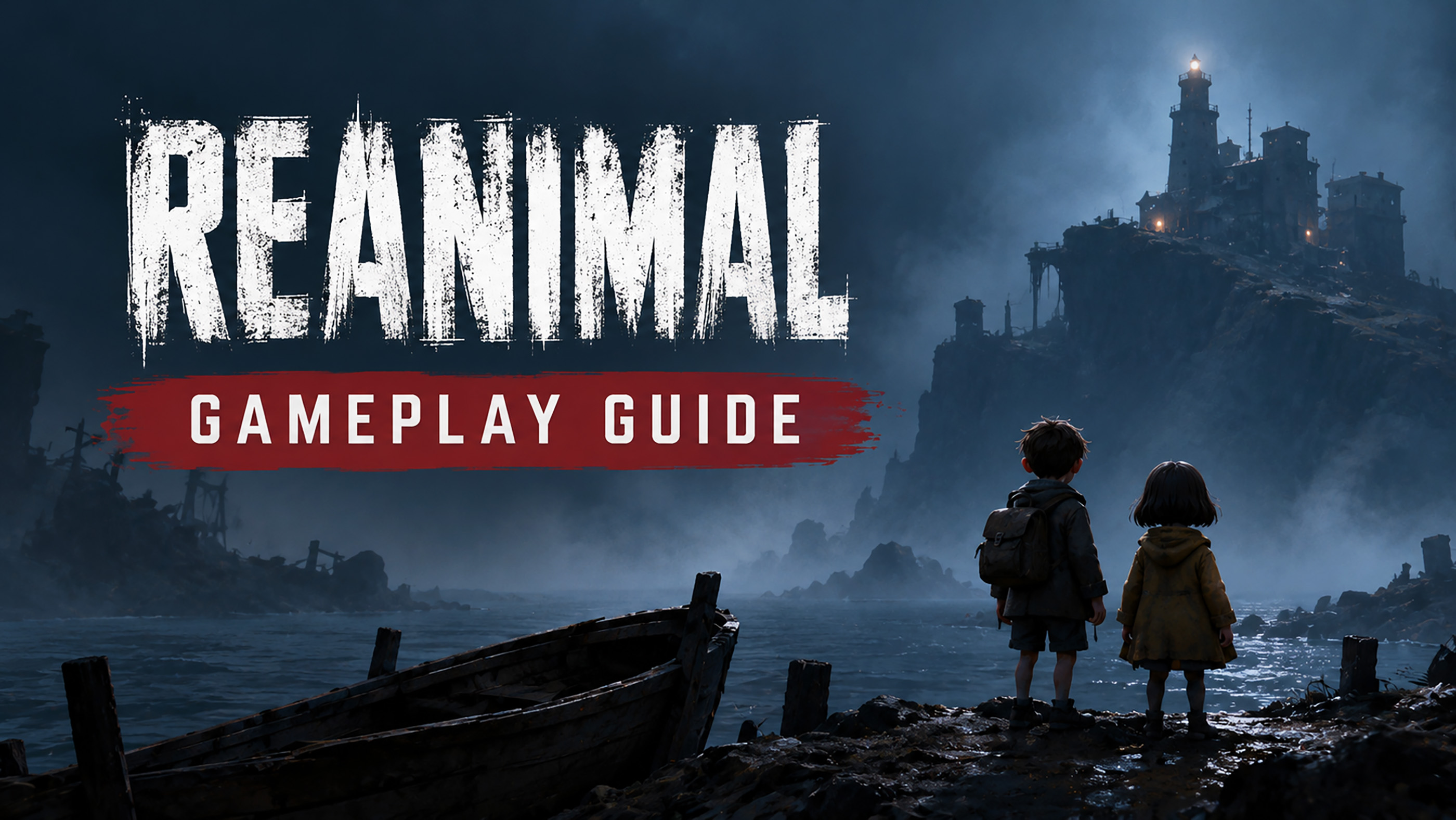
REANIMAL is the kind of horror game where an ordinary doorway can feel more threatening than a monster. You might spend several minutes exploring an abandoned building, listening to distant noises and wondering what happened there. Then something moves, and suddenly the only thing that matters is finding a way out.
Developed by Tarsier Studios, the creators of Little Nightmares and Little Nightmares II, REANIMAL is a cinematic horror adventure built around exploration, environmental puzzles, stealth and cooperation.
Released on February 13, 2026, the game follows two siblings searching for their missing friends on a nightmarish island. You can experience the adventure alone or with another player through local or online cooperative play.
This REANIMAL gameplay guide explains how the game works, including its story, movement, shared camera, puzzles, monster encounters, boat exploration, multiplayer features and the mechanics that distinguish it from other horror games.
What Type of Game Is REANIMAL?
REANIMAL is a third person horror adventure with puzzle solving, cinematic platforming and stealth elements.
Rather than focusing on collecting weapons or defeating large numbers of enemies, the game places you in dangerous environments where observation, timing and cooperation are essential.
You explore abandoned locations, interact with objects, solve environmental obstacles and try to survive encounters with disturbing creatures.
Its structure is primarily a story driven adventure. Although there are optional locations and secrets to discover, REANIMAL is not a conventional open world survival game.
There is no base building, hunger management or extensive crafting system. The focus remains on the journey and the terrifying situations the characters encounter.
What Is the Story of REANIMAL?
REANIMAL follows two orphaned siblings known as the Boy and the Girl.
After being reunited, they begin searching for their missing friends, Hood, Bucket and Bandage. Their journey takes them through a hostile island filled with abandoned places, unsettling creatures and reminders of a troubled past.
The children are not simply exploring an unfamiliar location. They are returning to a place connected to their own history, and the environments gradually reveal fragments of what happened there.
The story combines horror with themes of friendship, childhood trauma, loss and the desire to protect people who matter to you.
Much of the narrative is deliberately open to interpretation. Rather than explaining every mystery through lengthy conversations, the game encourages players to examine the environments and draw connections between what they discover.
How REANIMAL Gameplay Works
The central gameplay loop involves exploring an area, identifying a route forward, overcoming environmental obstacles and surviving whatever threatens the children.
Some sections are relatively quiet. You might search an abandoned building, inspect the surroundings or work out how to reach an inaccessible platform.
Other sections introduce enemies that force you to hide, move carefully or escape before you are caught.
The game regularly shifts between exploration, puzzles and intense cinematic sequences. These changes in pace are important because they prevent every encounter from feeling like the same challenge.
Progression is driven by reaching new locations and advancing the story rather than earning experience points or upgrading a character through a skill tree.
How Movement and Platforming Work
Movement is relatively straightforward, but the environments make even simple actions feel tense.
The children can move through three dimensional spaces, navigate obstacles, climb where appropriate and interact with objects needed to progress.
Platforming challenges involve judging distances, recognising usable surfaces and moving through environments that are not always safe.
Some sequences require quick reactions, particularly when an enemy is pursuing you or the environment is changing around the characters.
Unlike a traditional platformer, REANIMAL does not rely on elaborate jumping combinations or an extensive collection of movement upgrades. Its platforming is designed around the atmosphere and circumstances of each scene.
How the Shared Camera Works
One of REANIMAL's most distinctive mechanics is its shared, directed camera.
Instead of giving each character a completely independent viewpoint, the camera is designed to keep the action within a carefully controlled cinematic composition.
During cooperative play, both characters share the same view. This allows the developers to control what players can see and, just as importantly, what remains hidden.
The camera can make corridors feel narrow, rooms feel enormous and distant movement seem particularly threatening.
It also affects cooperation. Players need to remain aware of each other's position rather than treating the environment as two entirely separate adventures.
This shared perspective is a deliberate part of the horror design, not simply a limitation of the multiplayer system.
How Puzzles Work in REANIMAL
REANIMAL uses environmental puzzles that fit naturally into its locations.
Instead of solving abstract riddles through separate puzzle screens, you examine the environment, identify interactive objects and work out how to move forward.
A puzzle might involve opening a blocked passage, reaching an elevated area, manipulating an object or coordinating actions between the two characters.
Many solutions depend on noticing something in the surroundings rather than collecting a large inventory of unrelated items.
In cooperative play, communication can make these challenges easier. One player may notice an important detail while the other is concentrating on a different part of the environment.
When playing alone, the companion character helps maintain the two character structure of the adventure.
Cooperative Gameplay and Teamwork
REANIMAL is designed around two characters who need to survive together.
Cooperation is not limited to having another player standing beside you. The siblings must navigate the same environments, deal with shared threats and overcome obstacles that are connected to their journey.
Some situations involve working together to progress, while others require both players to react quickly when danger appears.
The shared camera reinforces this connection by keeping the characters within the same cinematic space.
For the best experience, communicate clearly and avoid rushing ahead when your partner is still examining the surroundings.
Can You Play REANIMAL Alone?
Yes. REANIMAL is fully playable in single player.
When you play alone, the other sibling is controlled by the game. This allows the story and cooperative interactions to continue without requiring a second human player.
The experience remains focused on the relationship between the two children, even when only one person is controlling the action.
Single player is a good choice if you prefer exploring at your own pace and concentrating on the atmosphere without discussing every puzzle with another person.
How Local and Online Co-op Work
REANIMAL supports two player cooperative gameplay through both local and online play.
Local co-op allows two people to experience the adventure together on the same system using the shared camera.
Online co-op allows players to connect remotely and progress through the story together.
Because the game uses a shared cinematic perspective, local play does not rely on a conventional split screen layout.
The game also supports crossplay, allowing friends on supported platforms to play together.
Does REANIMAL Have a Friend's Pass?
Yes. REANIMAL supports Friend's Pass.
This feature allows a player who owns the game to invite a friend to join the cooperative adventure without requiring that friend to purchase a separate full copy.
The invited player needs access to the appropriate Friend's Pass version, and the usual platform and online requirements still apply.
Friend's Pass is particularly useful for a game designed around two characters because it makes it easier to experience the story with someone else.
How Stealth Works in REANIMAL
Stealth is an important part of surviving the island's dangerous inhabitants.
Some encounters are designed around avoiding detection rather than confronting the threat directly.
You may need to move carefully, use environmental cover, wait for an enemy to change position or identify a safer route through an area.
Observation is often more useful than speed. Before moving into an exposed space, look at where the creature is positioned and how it behaves.
However, stealth does not mean remaining hidden throughout the entire adventure. Some encounters turn into escape sequences where moving quickly becomes essential.
Monster Encounters and Chase Sequences
REANIMAL features grotesque creatures designed to make the children feel vulnerable.
These monsters are closely connected to the game's unsettling visual style and the troubled history surrounding its characters.
Encounters vary in presentation. Some threats create tension through their presence, while others actively pursue the children and force an immediate response.
During chase sequences, the challenge is usually to recognise the intended escape route and react to obstacles without losing momentum.
When an encounter begins, pay attention to the environment. The way forward is often more important than the creature itself.
Does REANIMAL Have Combat?
REANIMAL is not a conventional combat focused horror game.
Its gameplay primarily revolves around exploration, puzzle solving, stealth and escaping dangerous encounters.
There are situations involving direct physical confrontation or the use of objects against threats, but these are contextual parts of the adventure rather than an extensive fighting system.
You should not expect a large weapon inventory, character combat builds or repeated battles designed around collecting loot.
The children are vulnerable, and the game uses that vulnerability to maintain tension.
Can You Die in REANIMAL?
Yes. Unlike a purely relaxing exploration game, REANIMAL includes dangerous situations where mistakes can lead to the characters being caught or killed.
Enemy encounters, environmental hazards and chase sequences can require multiple attempts.
The game uses checkpoints to let players retry sections rather than restarting the entire adventure after a mistake.
Learning from an unsuccessful attempt is part of the experience. You may discover where a creature appears, which route is safe or how an obstacle should be approached.
Exploring the Island
The island is one of REANIMAL's most important characters.
Its locations include abandoned structures, industrial environments, unsettling interiors and other places that suggest a history extending beyond the children's immediate journey.
The game encourages you to notice environmental details instead of simply following the most obvious route.
Objects, architecture and visual clues can suggest what happened in a location without explicitly explaining it.
Although the main adventure follows a directed path, there are optional areas worth investigating.
How Boat Exploration Works
Boats play an important role in REANIMAL's exploration.
The siblings travel across water to reach different parts of the island and continue their search for missing friends.
Boat sequences provide a change from exploring buildings and navigating dangerous spaces on foot.
They also help establish the scale of the world. Water separates locations, creating moments of uncertainty about what might be waiting at the next destination.
REANIMAL does not treat sailing as a complex naval simulation with ship upgrades and resource management. Boats are integrated into the adventure and its exploration mechanics.
Is REANIMAL an Open World Game?
No. REANIMAL is a directed, story driven horror adventure rather than a traditional open world game.
There are places to explore beyond the immediate main route, and the game includes optional discoveries.
However, you should not expect an enormous map filled with unrelated side quests, crafting activities and freely selectable missions.
The environments are designed to support a particular journey, with pacing and camera direction used to build suspense.
Collectibles, Secrets and Optional Exploration
REANIMAL rewards players who investigate the environment instead of rushing directly toward the next objective.
Optional discoveries include collectible masks and hidden details connected to the world.
Some secrets are located away from the most obvious route, encouraging you to examine corners, side passages and unusual environmental features.
The main story can be experienced without finding every collectible, but searching thoroughly gives you more reasons to revisit the adventure.
Collectibles also support the game's visual identity, allowing players to discover additional appearances for the characters.
What Are Masks in REANIMAL?
Masks are collectible cosmetic items associated with the children's appearance.
They fit the game's unsettling character designs and provide an additional reason to explore optional locations.
Some masks have also been offered through special editions or promotional bonuses.
They should not be confused with RPG equipment that increases health, improves damage or unlocks a skill tree.
Does REANIMAL Have Character Upgrades?
REANIMAL does not use a traditional RPG progression system.
There are no conventional character levels, experience point trees or elaborate equipment builds.
Progression comes from moving through the story, solving environmental problems and reaching new areas.
The game introduces different situations and interactions as the adventure develops rather than relying on a constant stream of statistical upgrades.
How REANIMAL Creates Horror
REANIMAL relies heavily on atmosphere and anticipation.
The game often allows you to see only part of an environment, leaving the rest hidden beyond the camera's view or in darkness.
Unusual architecture, distorted creatures and unsettling sound effects make ordinary spaces feel unsafe.
The contrast between the small children and the enormous environments also contributes to the tension.
Rather than presenting every threat immediately, the game often lets the surroundings suggest that something terrible might be nearby.
Visual Design and Environmental Storytelling
Tarsier Studios is known for creating unsettling worlds that communicate through visual details.
REANIMAL continues that approach with distorted character designs, abandoned locations and environments that feel familiar but deeply wrong.
The creatures and children draw inspiration from fragments of the characters' troubled past.
This gives the visual design a narrative purpose. The monsters are not simply frightening obstacles placed in random rooms. Their appearance contributes to the mystery surrounding the island.
The game rarely needs a character to explain that a location is dangerous. The environment usually communicates that feeling before anything attacks.
Sound Design and Music
Sound is essential to REANIMAL's atmosphere.
Environmental noises, distant movement and unsettling audio cues help create tension even when nothing threatening is visible.
Quiet moments are particularly important because they make sudden changes in sound more noticeable.
Playing with headphones can make it easier to appreciate the direction and detail of the game's audio.
The soundtrack supports the atmosphere without turning every scene into a constant dramatic confrontation.
How REANIMAL Compares With Little Nightmares
REANIMAL shares important creative influences with Little Nightmares because it comes from the studio responsible for the first two games in that series.
Both use vulnerable characters, disturbing environments, environmental puzzles and cinematic horror.
However, REANIMAL places a stronger emphasis on two characters experiencing the journey together.
Its shared camera, local and online cooperative options, and exploration by boat give it a different structure.
REANIMAL is also a separate game with its own characters, setting and story. It is not a direct sequel to Little Nightmares II.
REANIMAL Platforms and Release Date
REANIMAL was released on February 13, 2026.
The game launched for PlayStation 5, Xbox Series X|S, Nintendo Switch 2 and PC.
Its cooperative features are available across supported platforms, although online access requirements can depend on the platform being used.
REANIMAL Gameplay FAQ
Is REANIMAL a horror game?
Yes. REANIMAL is a cinematic horror adventure focused on disturbing environments, frightening creatures, stealth, exploration and survival.
Is REANIMAL single player or multiplayer?
Both. You can play alone with a computer controlled companion or experience the adventure with another player through local or online co-op.
Does REANIMAL support split screen?
No conventional split screen is needed. REANIMAL uses a shared camera that keeps both characters within the same cinematic view during cooperative play.
Does REANIMAL support crossplay?
Yes. Crossplay is supported between compatible platforms.
Can a friend play REANIMAL without buying it?
Yes. Friend's Pass allows an eligible invited player to join someone who owns the full game, subject to the applicable platform requirements.
Is REANIMAL an open world game?
No. It is a story driven adventure with optional exploration rather than a fully open world game.
Does REANIMAL have puzzles?
Yes. Environmental puzzles are a major part of the gameplay, including challenges involving objects, movement and cooperation between the siblings.
Can you fight monsters in REANIMAL?
Some situations involve physical confrontation, but REANIMAL does not have an extensive traditional combat system. Avoiding danger, escaping threats and solving environmental challenges are more important.
Do you need to play Little Nightmares before REANIMAL?
No. REANIMAL tells a separate story with different characters. Familiarity with Little Nightmares is not required.
Is REANIMAL suitable for children?
Despite featuring child protagonists, REANIMAL contains disturbing imagery, frightening creatures, violence and intense horror sequences. It is not designed as a lighthearted children's adventure.
Comments
No comments yet. Be the first to share your thoughts!