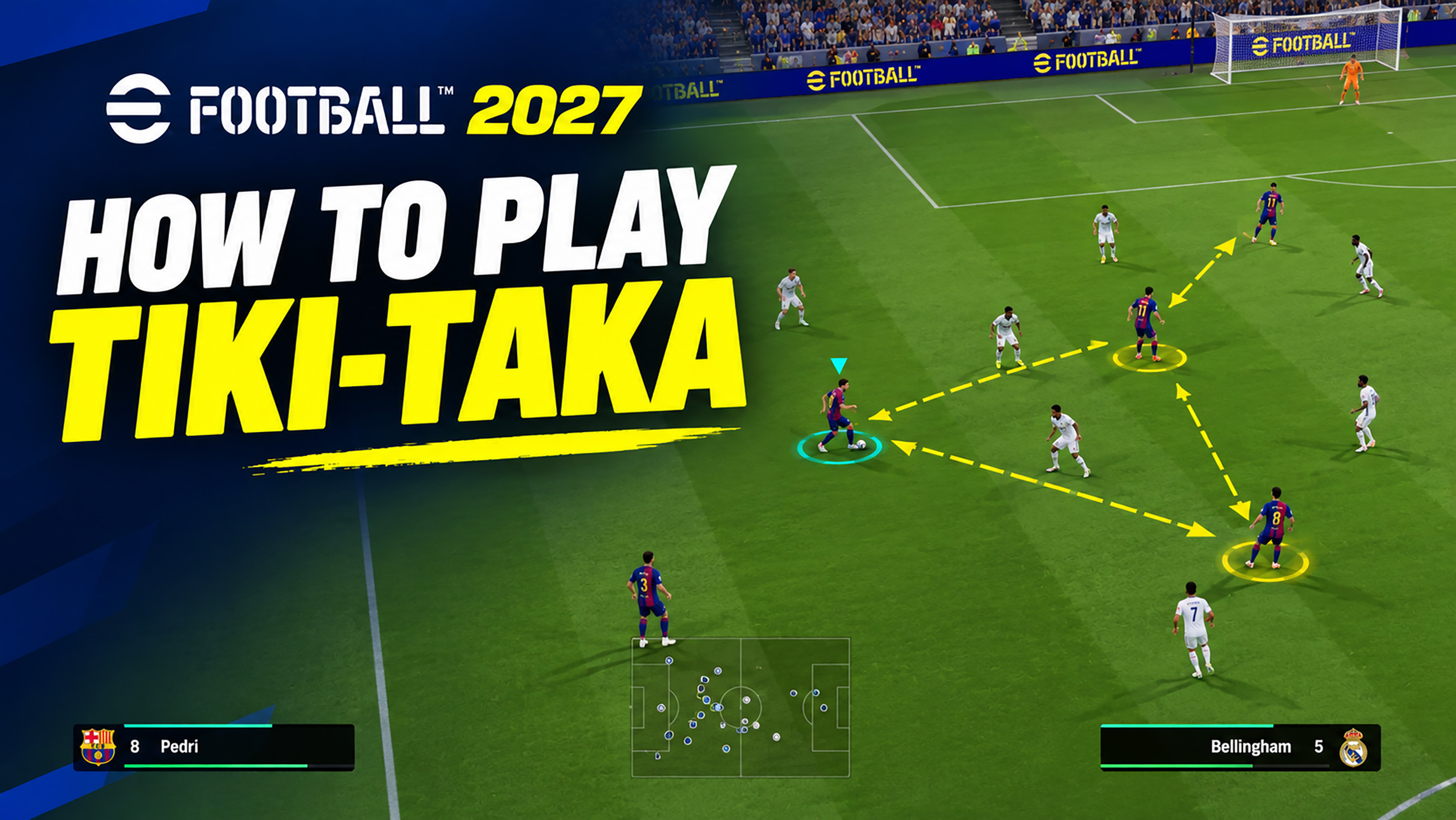
Tiki taka in eFootball 2027 is not about collecting possession for the sake of it. The aim is to keep the ball moving through short combinations, create passing triangles, pull defenders away from their positions and attack the space that appears.
It can be one of the most satisfying ways to play eFootball 2027, especially against opponents who constantly press. But it also requires patience. If every third pass is an ambitious through ball, you are not really playing tiki taka. The ball needs to do most of the travelling while your players continually offer new passing angles.
The current tactical system gives you two particularly interesting foundations for this style: Possession Game and the newer Overload Team Playstyle. Both can produce excellent combination football, but they behave differently.
Best Team Playstyle for Tiki Taka
Possession Game remains the natural starting point for a traditional tiki taka setup in eFootball 2027.
Players position themselves to support possession and generally give the ball carrier shorter passing options. This makes it easier to create the triangles that tiki taka depends on rather than having teammates immediately sprint away looking for a counterattack.
Use a manager with strong proficiency in Possession Game if this is going to be your main identity.
What About Overload?
Overload is also extremely interesting for tiki taka in eFootball 2027. It concentrates players around the side where the ball is located, creating numerical superiority and shorter passing distances.
That can produce beautiful combinations in crowded areas. The difference is that Overload deliberately pulls more players toward the active side, whereas Possession Game provides a more conventional possession structure.
For classic tiki taka, start with Possession Game. If you prefer aggressively creating local passing combinations around the ball, experiment with Overload.
Best Formation for Tiki Taka in eFootball 2027
A 433 is one of the safest formations for this style because it naturally creates triangles across the pitch.
| Position | Job in Tiki Taka |
|---|---|
| GK | Provides a safe option when building from the back |
| CB | Circulate possession and find midfield |
| Full Back | Provide width and another passing angle |
| DMF | Connect defence and midfield while protecting transitions |
| CMF | Keep combinations moving and support both sides |
| CMF / AMF | Receive between lines and create chances |
| Wide Forward | Stretch the defence or combine inside |
| CF | Link play, occupy centre backs and attack openings |
Do not become obsessed with copying an exact formation from somebody else. Tiki taka depends more on distances between players than whether your CMF is positioned a few pixels higher on the Game Plan screen.
Your objective is simple: when one player receives the ball, there should ideally be two or three sensible options nearby.
Use Fluid Formation to Improve the Shape
eFootball 2027 adds more tactical flexibility through Fluid Formation, allowing your attacking and defensive structures to differ.
This is very useful for possession football. You might defend with a conventional back four, then allow your shape to become more expansive when you have possession.
For example, a full back can take a more advanced position during attacks while the rest of the team reorganises around that movement. This can create an additional passing option without forcing you to defend with the same aggressive shape.
Do not make the attacking structure too crowded. Tiki taka needs nearby support, but it still needs width and depth. Eleven players standing in the same central area simply gives the opponent less space to defend.
Build Triangles Everywhere
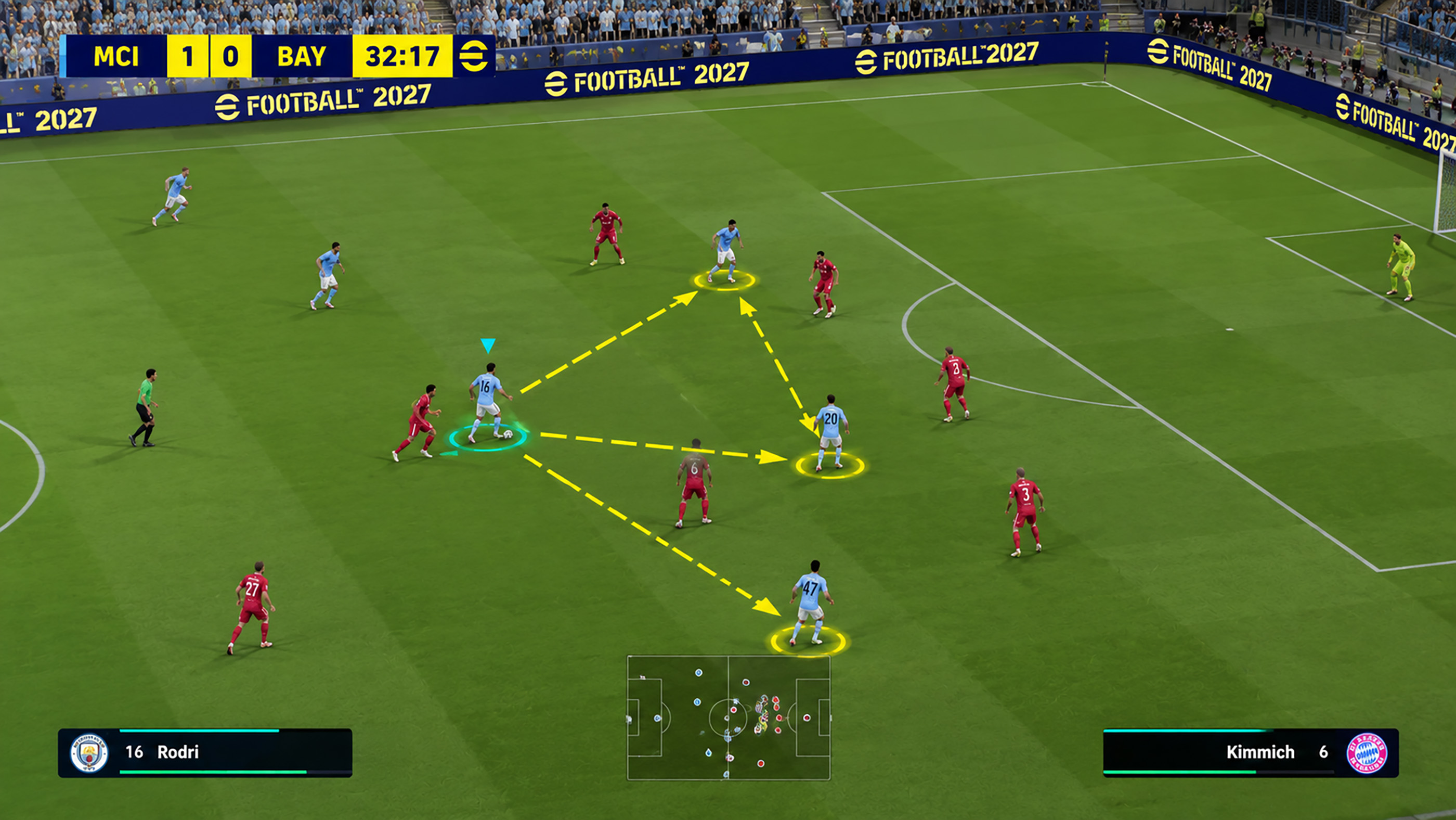
The triangle is the basic shape behind good possession football. Imagine your left centre back has possession. The left back may provide one option while the defensive midfielder provides another. Pass into midfield and the nearby central midfielder and defender can become the next two options.
You are continually creating a new triangle around whoever receives the ball.
Do not watch only the player in possession. Look at the players around him. The next pass becomes much easier when you already know where the second and third options are.
Stop Holding Dash All the Time
This is one of the biggest differences between effective tiki taka and rushed eFootball. You do not need to sprint every time somebody receives the ball. Constant dashing can make close control more difficult and encourages you to run into pressure rather than move the opposition with the ball.
Receive the pass, assess the defender and move naturally. Use acceleration when space actually opens or when you need to escape a defender who has committed.
The change of pace becomes far more dangerous when you have spent the previous few seconds moving the ball calmly.
Pass and Move, Not Pass and Watch
A tiki taka sequence should change the picture after almost every pass. One twos and Pass and Go actions are particularly useful because the passer immediately becomes another attacking option. Instead of making a pass and disappearing from the move, that player can continue into space and force a defender to decide whether to follow.
Do not trigger a forward run after every pass, however. Too many simultaneous forward runs can destroy the short distances that made the possession possible in the first place.
Use them when you see a defender step toward the ball carrier or when there is genuine space behind the defensive line.
Use the Third Man
The best passing combination is not always A to B and back to A. Suppose your CMF wants to find the striker, but the direct lane is blocked. Pass to another midfielder first. The defender reacts to that pass, the angle changes and the second midfielder can now find the striker.
That third player is often what breaks an organised defence. When a direct pass looks dangerous, ask whether another teammate can become the bridge instead.
Do Not Force Through Balls
Through balls are useful in tiki taka, but they should normally finish the combination rather than replace it. If you repeatedly attempt them while the opponent has several defenders between the ball and goal, possession will disappear quickly.
Move the defence first. Short pass, recycle, switch the angle, play another combination and wait for a defender to step forward. Then use the through ball when a runner actually has space to attack. The opening creates the through ball. The through ball does not create the opening by itself.
Recycle the Ball When the Attack Is Closed
One of the hardest habits to learn is going backwards when you are already near the penalty area.
If the centre is packed, there is nothing wrong with returning the ball to a midfielder, full back or even a centre back. The opponent then has a decision to make: stay deep and let you keep possession, or step forward and create space behind the press.
Tiki taka becomes much more effective when you stop treating every backward pass as a failed attack.
Use the Goalkeeper in Your Build Up
Against aggressive pressure, your goalkeeper is an extra passing option. If both centre backs are being pressed, returning the ball to the keeper can change the passing angle and force the opponent's forwards to move again. Once they commit, another route into midfield or toward a full back may open.
The important word is safe. Do not casually play blind passes across your own penalty area. Using the goalkeeper should create an advantage, not provide your opponent with the easiest goal of the match.
Choose Midfielders Who Can Receive Under Pressure
Passing statistics matter, but your midfielders also need to receive, turn and protect the ball. Look for players with strong Low Pass, Ball Control and Tight Possession. Good awareness and suitable Playing Styles also influence how useful they feel within the structure.
A midfielder who can receive with a defender nearby and calmly release the next pass is often more valuable to tiki taka than a faster player who constantly wants open grass in front of him.
Your DMF Is the Safety Valve
The defensive midfielder is one of the most important players in the system. When the forward route disappears, the DMF gives you somewhere to recycle possession. When a full back advances, the midfield structure also becomes important for protecting the space behind the attack.
Avoid dragging your holding midfielder unnecessarily far forward simply because you want another body around the penalty area. Somebody needs to connect the centre backs with the rest of the team and help deal with counters when possession is lost.
Use Width to Create Space in the Middle
Tiki taka is associated with short central passing, but width is essential to making those passes possible. If both wide players constantly move into the centre, the opponent can compress the middle and defend several passing lanes at once.
Keep at least one credible wide option. When the opponent shifts toward the touchline to defend it, central space increases. If they refuse to shift, continue using the free player outside.
Switch the Play Against Compact Opponents
This becomes particularly useful with Overload. If several players and defenders have moved toward one side of the pitch, the opposite side can become the most valuable space on the field.
Do not spend ten passes trying to squeeze through four defenders simply because you want every move to remain short. Recycling through midfield and moving the attack to the other side is still possession football.
A good tiki taka player knows when to play five metres and when the entire defence needs to be moved twenty metres.
Use Finesse Dribbling to Protect the Passing Angle
Finesse Dribbling can be useful when a defender approaches but you do not want to abandon the combination.
Small controlled movements can help you change the angle of your body, protect possession and create a clearer passing lane. You do not always need a skill move or sprint to beat pressure. Sometimes moving half a step away from the defender is enough to make the next pass possible.
Face the Direction of Your Pass
Quick football does not mean every pass should be played instantly regardless of body position. When possible, receive in a way that prepares the next action. A player facing the correct direction can move the ball much more naturally than somebody trying to force an awkward pass while turning.
Think before the ball arrives: where is the pressure coming from, and where do you want the next pass to go?
Know When to Break the Rhythm
If every pass has exactly the same tempo, good opponents eventually read the pattern.
Move the ball patiently, then suddenly accelerate the attack when a defender steps out. A sharp one two, quick through ball or burst into the newly opened space can turn harmless possession into a chance within seconds. The slow phase moves the defence. The fast phase exploits what that movement created.
How to Play Against a High Press
Do not respond to pressure by automatically kicking the ball forward. First identify who is creating the press. If your opponent sends a second defender toward the ball, another player is becoming less protected somewhere else.
Use short passes to attract pressure, then find the free player. Returning the ball backwards is perfectly acceptable if it allows you to escape on the opposite side.
If the opponent commits too many players and a clear forward lane appears, attack it. Tiki taka does not require you to make another five passes after the defence has already been beaten.
How to Break a Deep Defence
A low block presents the opposite problem. You may have plenty of possession but very little space.
Do not repeatedly force passes into the striker. Move the ball from side to side, use your midfielders between the lines and occasionally send a player beyond the defence with a one two.
The purpose of all those passes is to make one defender leave the shape. When that happens, play into the space they abandoned rather than continuing the passing sequence simply because it looks attractive.
Press Immediately After Losing the Ball, but Stay Sensible
Possession teams are vulnerable immediately after losing the ball because several players may be positioned ahead of it.
Your first reaction should be to close the nearby passing options and make the opponent uncomfortable. Match up is useful for controlling space and blocking a likely pass, while pressure can challenge the ball carrier when the moment is right.
Do not turn every turnover into a wild chase. If the opponent escapes the first pressure, recover your defensive shape instead of dragging player after player out of position.
A Simple Tiki Taka Pattern to Practise
Start with your centre back and play into the DMF. Move it to a CMF, then out toward the full back or winger. If the opponent follows, return inside through the midfielder and look for the striker or opposite side. The important part is not memorising those exact passes. Watch how the opponent reacts to each one.
If nobody presses, keep advancing. If one defender presses, use the free teammate. If several players shift toward the ball, recycle and attack the space they left behind.
Best Formation Alternatives for Tiki Taka
The 4 3 3 is not your only option. A 4 2 3 1 gives you an extra layer of midfield security and a natural player between the lines. A 4 3 1 2 can produce excellent central combinations if you enjoy narrow football, although you need a plan for creating width.
More adventurous players can use structures such as 3 2 4 1 to create numerous passing options in midfield and attack, but losing possession can become considerably more dangerous.
Choose the formation that gives you comfortable passing distances rather than simply copying whichever setup is currently popular.
Common Tiki Taka Mistakes in eFootball 2027
The biggest mistake is confusing possession with progress. You can complete 150 short passes and create almost nothing if every pass happens in front of the opponent.
Other common problems include sprinting too much, forcing through balls, crowding the centre, pushing every midfielder forward and refusing to pass backwards.
Good tiki taka has a purpose. Keep the ball to manipulate the defence, recognise the moment a gap appears and then attack that gap decisively.
How to Know When Your Tiki Taka Is Working
Do not judge the tactic purely by your possession percentage. Look at the quality of your attacks. Are your midfielders receiving with options around them? Are opponents being forced to leave their positions? Can you escape pressure without immediately clearing the ball? Are you reaching the penalty area with players facing goal rather than desperately chasing loose passes?
When those things start happening regularly, the system is working. Possession is simply the consequence.
The best tiki taka in eFootball 2027 feels patient without becoming passive. Move the opponent with the ball, keep your passing triangles alive and resist the temptation to force the final pass. When the defence finally breaks its shape, that is when the pretty football should become ruthless.
Learn more about how Tiki Taka works in real football.
Comments
No comments yet. Be the first to share your thoughts!