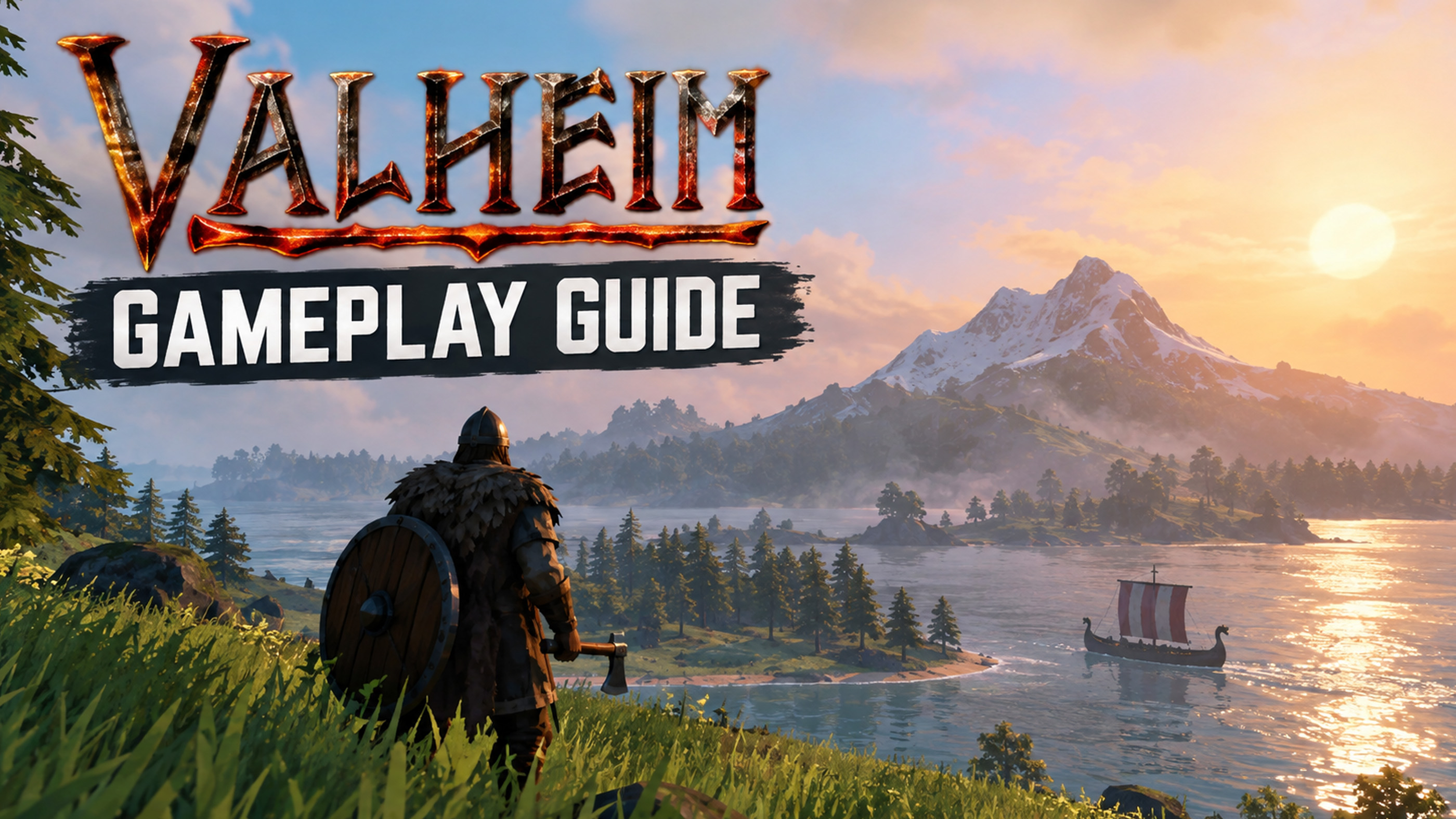
Valheim is a Viking survival game where the world does not tell you exactly what to do next. You begin with almost nothing, gather resources, build a shelter, craft equipment and gradually discover that the peaceful forest surrounding your first home is only a small part of a much more dangerous world.
Developed by Iron Gate Studio and published by Coffee Stain Publishing, Valheim combines open world exploration, survival, building, crafting and action combat. Its progression is shaped by the bosses you defeat, the resources you discover and the biomes you learn to survive.
This Valheim gameplay guide explains how the game works, from its Unity engine and procedurally generated world to combat mechanics, construction physics, character progression, multiplayer and the systems that make every expedition feel different.
What Type of Game Is Valheim?
Valheim is an open world survival and exploration game inspired by Norse mythology. You play as a fallen Viking warrior sent to Valheim, a realm where powerful enemies known as the Forsaken must be defeated.
Rather than following a conventional story campaign with a constant stream of quest markers, you decide how to approach the world. You can spend an evening building a settlement, explore an unfamiliar island, gather materials for better equipment or prepare for a boss battle.
The game supports solo play and cooperative multiplayer, allowing up to ten players in a world under the standard player limit.
Although Valheim contains RPG elements, it does not use a traditional character level system. Your abilities improve through use, while your equipment, food and access to new crafting materials determine much of your practical strength.
What Game Engine Does Valheim Use?
Valheim is built using the Unity game engine. Unity handles the game's rendering, physics, animation, audio and other technical systems, while Iron Gate has developed the survival mechanics, combat, procedural world generation and building systems that define the experience.
The game has a distinctive visual style. Characters and environmental objects often use relatively simple, low polygon models and pixelated textures, while lighting, shadows, atmospheric effects and weather give the landscape a surprisingly rich appearance.
This contrast is intentional. A forest can look simple when viewed up close but become dramatic when sunlight filters through the trees or fog settles over the ground.
Valheim's world is also persistent. Buildings, terrain changes and other alterations remain part of your saved world unless they are changed or removed. The game is not generating a completely new map every time you return.
How Valheim's World Generation Works
Every Valheim world is created from a seed. The seed determines the arrangement of the landscape, including coastlines, islands, biomes and many important locations.
Using the same seed with compatible world generation rules can produce the same underlying world layout, although changes introduced through game updates may affect generation details.
The world is large, but it is not infinite. It consists of landmasses separated by oceans, encouraging players to explore on foot during the early game and eventually use boats to reach distant regions.
Different biomes contain their own resources, enemies, vegetation, structures and environmental hazards. Progression often requires travelling farther from the relatively safe starting area.
Is Valheim's Map Random Every Time?
The map is procedurally generated when the world is created. It is not randomly rearranged during normal gameplay.
If you begin another world with a different seed, you can encounter a completely different arrangement of islands and locations. That makes exploration a major part of the experience even after you understand the game's mechanics.
The Main Valheim Gameplay Loop
Valheim revolves around a repeating cycle of preparation, exploration and progression.
You begin by gathering resources and making basic tools. Those tools let you collect better materials, which unlock stronger equipment and more advanced crafting stations. Improved equipment helps you survive tougher biomes and defeat bosses, opening the way to additional resources and technologies.
Between expeditions, you return to your base to repair equipment, cook food, process materials and improve your settlement.
The loop works because every new area presents a different problem. A better sword might solve a combat challenge, but it will not necessarily protect you from freezing temperatures, poison or a dangerous ocean crossing.
How Survival Works in Valheim
Valheim approaches survival differently from games where failing to eat eventually kills your character.
Food primarily increases your maximum health and stamina. You can remain alive without eating, but your character will be much weaker and less capable of surviving dangerous encounters.
Three different food effects can be active simultaneously. Each food provides a particular combination of health and stamina, while later recipes can also support Eitr, the resource used for magic.
Food effects weaken over time, reducing their benefits until they expire or are refreshed.
This makes cooking a major progression system rather than a minor activity. A carefully prepared meal can change how effectively your character fights, explores and survives.
Health, Stamina and Eitr Explained
Health
Health determines how much damage your character can survive. Your maximum health depends heavily on the food you have eaten, and regeneration is influenced by your current conditions and effects.
Stamina
Stamina is consumed by many physical actions, including sprinting, jumping, attacking, blocking and certain forms of movement.
Stamina management is one of Valheim's most important mechanics. If you exhaust it while fighting, you may be unable to defend yourself or escape.
Eitr
Eitr becomes relevant during later progression when magic equipment and suitable foods become available.
It acts as the resource used for magical abilities. Building around Eitr requires different food and equipment decisions from a character focused on conventional weapons and melee combat.
How the Rested and Comfort Systems Work
Rested is a beneficial status effect that improves health and stamina regeneration.
You can gain it by resting under suitable conditions, such as being sheltered near a fire. The duration depends on the comfort available in the resting area.
Furniture and other comfort providing objects can increase the comfort level, although the system does not simply reward placing unlimited copies of the same item.
Comfort gives base building a practical gameplay purpose. Improving your home can make future expeditions easier because you leave with a longer Rested bonus.
Weather, Temperature and Environmental Effects
The environment affects gameplay beyond appearance.
Rain and water can make your character Wet, which affects regeneration. Cold environments can apply additional penalties, while freezing conditions in dangerous regions can become life threatening without appropriate protection.
Fire, shelter, clothing, resistance effects and other preparations help counter these conditions.
Weather also changes visibility and the atmosphere of exploration. A familiar forest can become much harder to navigate during heavy rain or fog, especially when enemies are nearby.
How Combat Works in Valheim
Valheim uses real time action combat with melee weapons, bows, shields and later magical equipment.
Combat is built around positioning, attack timing, stamina and enemy behavior. Weapons have different attack patterns, damage types, ranges and secondary attacks.
Repeatedly attacking without considering stamina is usually ineffective against stronger enemies. You need to recognise attack animations, avoid unnecessary damage and choose when to commit.
Terrain also matters. Uneven ground can affect whether attacks connect, while obstacles, narrow passages and elevation can change how an encounter plays out.
Blocking, Parrying and Staggering
Blocking allows suitable equipment to reduce incoming damage. Shields are particularly useful, but different shield types encourage different approaches.
A well timed block with appropriate equipment can parry an attack, potentially staggering the enemy and creating an opportunity to deal additional damage.
Parrying is influenced by your equipment and defensive capabilities. It is not a universal answer to every enemy attack.
Staggering is important because a staggered enemy becomes vulnerable to additional damage. Learning when an enemy can be staggered is one of the biggest steps toward mastering melee combat.
Dodge Rolls and Invincibility Frames
Dodge rolling gives players a way to avoid attacks rather than absorbing them.
A correctly timed roll provides a brief period during which incoming damage can be avoided. This makes dodging useful against attacks that would be difficult or dangerous to block.
Rolling consumes stamina, so it cannot be used endlessly without consequences.
Valheim's combat rewards players who understand when to block, when to parry and when to dodge rather than relying exclusively on one defensive action.
Weapon Types and Damage Mechanics
Valheim includes several weapon categories, each suited to different situations.
Swords offer versatile melee combat, axes can serve as both tools and weapons, clubs provide blunt damage, and spears have their own attack characteristics. Polearms, knives, bows, crossbows and magical weapons broaden the available options as progression continues.
Enemies have resistances and weaknesses to different damage types, including blunt, slash, pierce and elemental damage.
Damage effectiveness therefore depends on more than the weapon's displayed number. Choosing the right damage type can make an encounter significantly easier.
Weapon quality, your relevant skill level and the enemy's defensive properties also affect the outcome.
How Skills and Character Progression Work
Valheim does not award conventional experience points that increase a single overall character level.
Instead, individual skills improve as you perform relevant actions. Using a weapon develops its associated skill, while activities such as running, jumping and sneaking improve their respective abilities.
Higher skills generally improve your effectiveness with the relevant activity, although the exact benefit depends on the skill.
Death can reduce skill progress, making survival valuable beyond simply protecting your equipment.
This creates a progression system where your character develops naturally through the actions you perform most often.
How Crafting and Technology Progression Work
Crafting recipes become available as you discover new materials and meet the necessary requirements.
The Workbench handles many early crafting and repair tasks. Later stations, including the Forge and more advanced facilities, allow you to process new materials and create stronger equipment.
Crafting stations can also be upgraded through nearby improvement structures, increasing the quality of equipment they can produce or improve.
This creates a strong connection between exploration and base development. Discovering a new resource may unlock a weapon, a crafting station, a building material or an entirely new production process.
Mining, Smelting and Resource Processing
Early progression eventually introduces mining and metalworking.
After obtaining the appropriate tools, you can mine ore deposits and process materials using structures such as Smelters and Charcoal Kilns.
More advanced metals require additional preparation, suitable crafting stations and access to increasingly dangerous regions.
Mining is not only about finding a deposit. You also need to transport heavy resources, defend the work area and decide whether to process materials locally or bring them back to your main settlement.
How Valheim's Building System Works
Valheim uses a modular building system. Players place individual pieces such as floors, walls, beams, roofs, stairs and decorative objects to create structures.
Construction is not completely freeform. Pieces connect through snap points and must satisfy structural support rules.
This allows considerable creativity while still requiring buildings to make physical sense within the game's construction system.
You can build anything from a small wooden cabin to elaborate settlements, towers, bridges and fortified compounds, provided the structure has sufficient support and the required materials are available.
Structural Integrity and Building Physics
One of Valheim's defining building mechanics is structural stability.
Building pieces receive support from the ground and connected structural elements. The farther a piece is from reliable support, the less stable it may become.
Construction colours indicate how well supported a piece is. Pieces that cannot maintain sufficient stability may break.
Different materials provide different construction possibilities. Stronger building materials and appropriate support structures make larger or taller designs possible.
This means building a large hall is not simply a matter of collecting enough wood. You must also think about how the roof and upper sections are supported.
Terrain Modification and World Persistence
Valheim allows players to modify terrain using appropriate tools.
You can flatten ground, raise or lower terrain, create defensive earthworks and prepare building sites. These changes remain part of the saved world.
Terrain modification can be useful for roads, farms, foundations and base defences.
However, large terrain projects require considerable work and resources, so planning before reshaping an entire hillside can save time.
How Farming and Animal Taming Work
Farming becomes increasingly important as you unlock crops and more advanced cooking recipes.
Different crops have environmental requirements, and some can only grow in suitable biomes. A cultivated field therefore needs more planning than simply placing seeds anywhere.
Valheim also allows certain animals to be tamed under appropriate conditions. Tamed animals can provide useful resources and, depending on the species, may reproduce when the required conditions are met.
Farming and taming help turn your settlement into a reliable source of food and materials rather than forcing every expedition to begin with another gathering trip.
Biomes and Environmental Progression
Biomes are central to Valheim's structure. Each introduces different enemies, resources, environmental conditions and progression challenges.
| Biome | Gameplay Characteristics |
|---|---|
| Meadows | Early survival, basic resources, hunting and first settlements |
| Black Forest | Mining, dungeons, stronger enemies and early metal progression |
| Swamp | Poison threats, difficult terrain and important iron resources |
| Mountains | Freezing conditions, steep terrain and advanced materials |
| Plains | Dangerous enemies, valuable resources and agricultural progression |
| Mistlands | Limited visibility, advanced crafting and the introduction of magic progression |
| Ashlands | Hostile volcanic environments, intense combat and advanced equipment |
| Deep North | Final biome introduced in Valheim 1.0, featuring extreme northern conditions, frozen terrain, new enemies, equipment, dungeons and progression challenges |
The Ocean also acts as an important travel environment, with its own dangers and resources.
Biome progression is not an absolute rule. You can enter dangerous regions earlier than intended, but surviving them without suitable equipment and preparation can be extremely difficult.
Bosses and Forsaken Powers
Boss encounters provide major progression milestones.
Players locate boss altars, gather the required summoning materials and challenge powerful enemies with distinct attacks and mechanics.
Defeating bosses provides important rewards and trophies. Placing a boss trophy at the Sacrificial Stones unlocks its corresponding Forsaken power.
You can select one Forsaken power at a time. These powers provide temporary benefits, such as improved stamina efficiency or other useful effects depending on the boss.
Bosses give Valheim a broad progression direction without preventing players from spending time on exploration, construction and other activities.
Dungeons, Caves and Special Locations
Exploration is not limited to the surface world.
Different biomes contain dungeons, caves, crypts and other locations with enemies, loot and materials needed for progression.
Some interiors are separate areas that must be entered, while other locations are part of the open landscape.
These environments reward preparation. Limited visibility, narrow passages and unfamiliar enemies can make a dungeon more dangerous than the surrounding biome.
How Sailing and Ocean Exploration Work
Sailing is a major part of Valheim because the world consists of separated islands and continents.
Players can construct different vessels as they progress. Larger ships generally offer better transport capabilities, but sailing still requires attention to wind, positioning and environmental hazards.
Wind direction affects how efficiently sail powered boats move. When the wind is unfavourable, you may need to change your route or use slower propulsion.
Ships also have durability and can be damaged. An ocean journey therefore carries genuine risk, especially when transporting valuable materials or travelling far from a safe landing point.
Portals and Fast Travel Mechanics
Portals allow rapid travel between connected locations.
They become available through progression and are extremely useful for linking settlements, resource outposts and exploration camps.
Portal restrictions are an important part of the default survival experience. Certain ores and metals cannot pass through ordinary portals, encouraging players to use ships and other transport methods.
World modifiers can alter some of these restrictions, and later progression introduces additional portal capabilities.
Portals reduce repetitive travel, but they do not completely remove the importance of planning expeditions.
Death, Tombstones and Equipment Recovery
When your character dies under standard survival rules, carried equipment is left at a tombstone that can be recovered.
Death also affects skill progression, creating a penalty beyond the inconvenience of retrieving your belongings.
After respawning, you may need to prepare replacement equipment and food before returning to the dangerous location.
World modifiers can change the consequences of death, allowing players to choose a more forgiving or demanding experience.
This recovery system makes preparation important because a poorly planned expedition can turn into a much longer rescue mission.
Enemy AI, Raids and World Events
Enemies in Valheim use different behavior patterns depending on their type. Some approach directly, others attack from range, and certain creatures become particularly dangerous in groups.
Enemies may react to players, structures and environmental conditions, creating encounters that are not always predictable.
Valheim also includes raids and other world events. These can bring hostile creatures toward a settlement, forcing players to defend their base.
Raid eligibility and enemy selection depend on progression and other game conditions. As you defeat bosses and advance through the world, the threats you encounter can change.
Base location, defensive construction and preparation therefore remain relevant even after you have built a comfortable home.
How Multiplayer Works in Valheim
Valheim supports cooperative multiplayer, allowing players to explore and develop a shared world.
Players can work together on construction, resource gathering, exploration and boss fights. The world remains persistent, so completed buildings and terrain changes can be used by everyone with access to the save.
Multiplayer also introduces practical choices. One player might focus on farming and food production while others mine, build or explore.
Combat difficulty can scale with nearby players, so bringing a group does not necessarily mean every enemy becomes trivial.
Valheim supports crossplay between supported platforms, subject to the available versions and multiplayer configuration.
Dedicated Servers and Persistent Worlds
Valheim can be played in locally hosted sessions or through dedicated servers.
A dedicated server allows a shared world to remain available while the server is running, even when the player who originally created the world is not personally playing.
This is useful for groups who want to build a long term settlement and explore at different times.
The world save stores important information about the environment, construction and progression. Keeping backups is sensible, especially before major updates or extensive building projects.
World Modifiers and Custom Difficulty
Valheim includes world modifiers that let players adjust several aspects of the experience.
Depending on the chosen settings, you can alter combat difficulty, resource rates, death penalties, portal behavior and other survival rules.
This allows the same game to support different preferences. Some players want a demanding survival adventure where mistakes carry serious consequences. Others prefer spending most of their time building settlements and exploring.
World modifiers are particularly useful for solo players or groups with limited time, although they can change the balance of progression significantly.
How Long Does Valheim Take to Complete?
Valheim does not have one fixed completion time because its structure is open ended.
A player who concentrates on defeating bosses and advancing through biomes will progress differently from somebody who spends dozens of hours building settlements, exploring islands and collecting resources.
The game's content also depends on its development version, so the number of available progression milestones can change as updates are released.
For many players, completing the available boss progression is only part of the experience. Building, exploration and multiplayer can continue long after the major objectives have been cleared.
Is Valheim Difficult for Beginners?
Valheim can be challenging, but much of its difficulty comes from understanding its systems rather than mastering extremely complicated controls.
Food, stamina, environmental protection, equipment preparation and enemy knowledge make a major difference.
New players often struggle because they enter dangerous biomes without suitable meals or equipment, fight while exhausted or travel too far from a safe recovery point.
Once those habits improve, the game becomes more manageable without losing its sense of danger.
What's New in Valheim 1.0 Gameplay?
Valheim's full release on September 9, 2026 introduced the Deep North as the game's final biome, completing the main biome progression. The update expanded the adventure with new enemies, weapons, armour, crafting materials and locations.
The Deep North introduces new environmental challenges, including deep snow and dangerous frozen surfaces. Players must adapt their exploration and survival strategies rather than relying entirely on equipment and techniques from earlier regions.
Version 1.0 also added more than 40 weapons, over 80 building pieces, new crafting equipment, additional food recipes, upgradeable pockets and achievements.
These additions make inventory management, combat preparation and construction more flexible while preserving Valheim's central gameplay loop of exploring, gathering, crafting, building and defeating powerful enemies.
Valheim Gameplay FAQ
Is Valheim a survival game or an RPG?
Valheim is primarily a survival and exploration game with RPG elements. It includes skill progression, equipment upgrades, boss encounters and different combat builds, but does not use a conventional character level system.
Does Valheim have a story?
Yes. The game has a Norse mythology inspired premise involving the Forsaken and the realm of Valheim. However, the story is presented through exploration, world details, boss progression and limited narrative guidance rather than a heavily scripted campaign.
Is Valheim's world infinite?
No. Each world is large but finite, with its layout generated from a seed.
Does Valheim use realistic physics?
Valheim uses physics systems for movement, collisions and various world interactions, but it is not intended as a fully realistic simulation. Its building stability, combat and environmental mechanics are designed primarily around gameplay.
Can you build anywhere in Valheim?
You can build in many areas provided you have the necessary materials and meet the relevant construction requirements. Terrain, structural support and certain location restrictions can affect what is possible.
Can you play Valheim without fighting bosses?
You can spend time exploring, building and gathering without immediately fighting bosses. However, defeating bosses is an important part of unlocking the normal progression path.
Does Valheim have magic?
Yes. Magic becomes available through later progression, introducing Eitr based equipment and abilities.
Is Valheim better solo or multiplayer?
Both are fully viable. Solo play offers more control over pacing and decisions, while multiplayer makes large construction projects and coordinated expeditions more convenient. The core survival and progression systems remain recognisable in either mode.
What makes Valheim different from other survival games?
Its combination of procedural exploration, biome based progression, skill development, food driven character statistics, structural building rules, sailing and boss encounters creates a distinctive rhythm. You are constantly preparing for the next journey while improving the home you return to.
Comments
No comments yet. Be the first to share your thoughts!