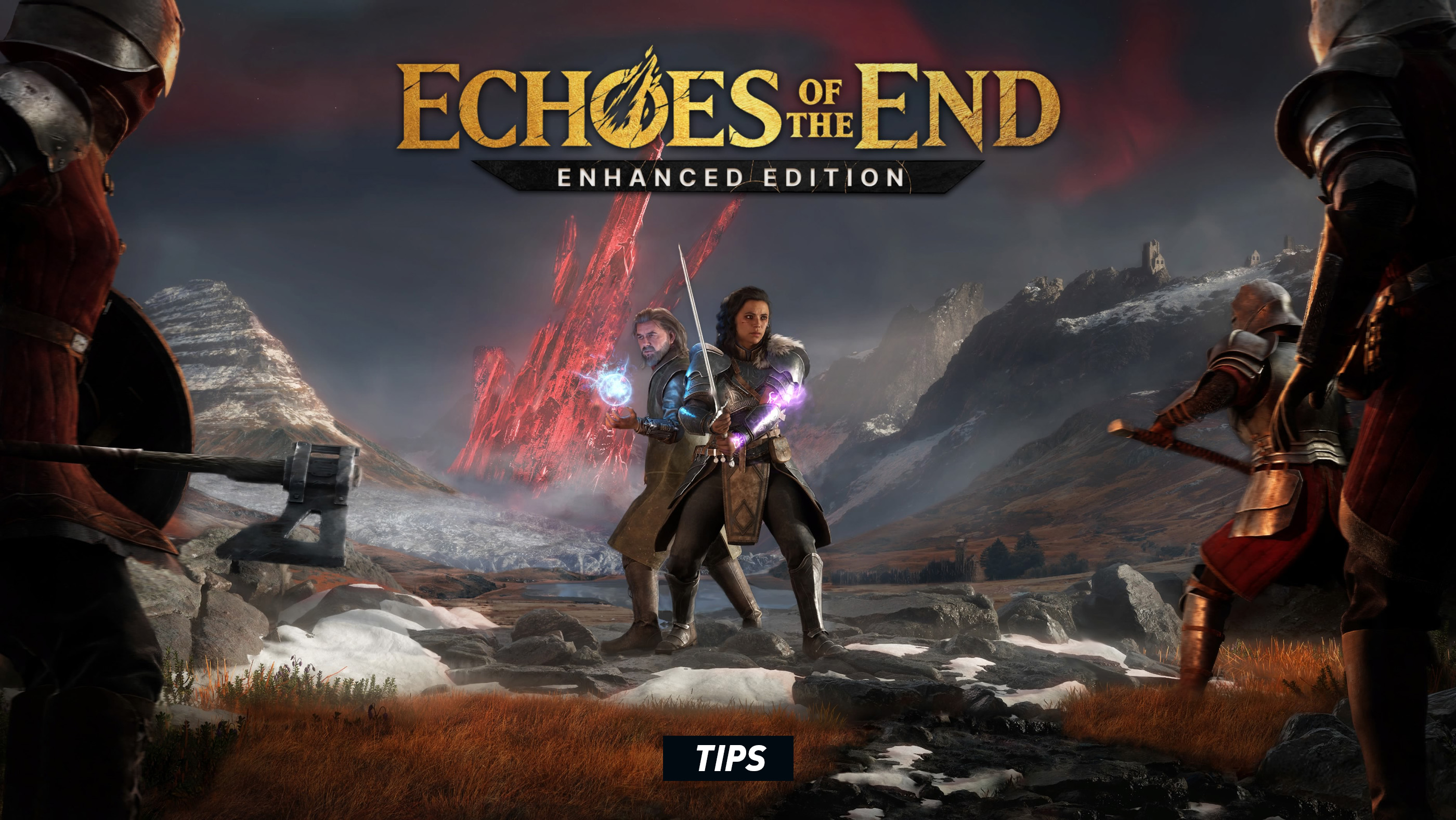
Echoes of the End: Enhanced Edition is at its best when swordplay, Vestige magic and companion abilities are treated as one connected combat system. Ryn can defend herself with conventional attacks and parries, but her greatest advantage is the ability to reshape a fight: interrupt enemies, manipulate their position, exploit the environment and create openings for more damaging attacks.
Outside combat, the same powers are used to reconstruct objects, manipulate gravity, reveal paths and solve cooperative puzzles with Abram and other companions. The game is largely chapter-driven, so careful exploration matters. Advancing too quickly can leave upgrades, lore and optional discoveries behind.
This guide covers the most useful beginner habits, advanced combat techniques, parry timing, Vestige combinations, companion commands, puzzles, traversal, equipment, difficulty settings, checkpoint management and New Game+ preparation.
Essential Echoes of the End Tips
- Use Light Attacks to test an opening instead of committing immediately to a long combo.
- Hold block while learning a new enemy, then begin practising the parry timing.
- Save Heavy Attacks for staggered enemies and confirmed openings.
- Use the longer double-tap roll to escape groups and large area attacks.
- Identify ranged enemies before engaging the main group.
- Use Vestige Powers to reposition opponents rather than focusing only on damage.
- Follow a companion stagger with a Heavy Attack or powerful ability.
- Search every side path before crossing an obvious point of no return.
- Look for matching shapes, energy paths and companion prompts during puzzles.
- Wait for the automatic-save indicator before ending a session.
- Change difficulty when combat pressure is preventing you from enjoying the story or puzzles.
- Review new equipment instead of assuming the item with the largest number is always best.
Fight Deliberately Rather Than Aggressively
Button-mashing is one of the fastest ways to lose control of a battle. Ryn's attacks have commitment, and enemies can punish an unfinished combo.
A safer combat rhythm is:
- Approach without immediately attacking.
- Observe the enemy's first action.
- Block, parry or dodge it.
- Answer with one or two Light Attacks.
- Stop and reassess.
- Use a Heavy Attack only after a genuine opening appears.
This rhythm may appear slower, but it prevents Ryn from being struck during an unnecessary third or fourth swing.
Do Not Finish Every Combo
A combo is an option, not an obligation. The moment an opponent begins a counterattack, stop pressing attack and prepare to defend.
Let Enemies Reveal Their Pattern
Many opponents repeat recognisable sequences. Spending the opening seconds defending can save much more health than trying to overpower them immediately.
Use Light Attacks as Safe Pressure
Light Attacks are quick enough to take advantage of brief openings. They are most reliable after a dodge, parry, companion hit or missed enemy strike.
Use one or two Light Attacks when:
- You do not yet know how long the opening will last.
- Another enemy is approaching.
- The target may recover quickly.
- You need to remain ready to dodge.
- You are building toward a stronger follow-up.
Confirm the Stagger Before Continuing
Some enemies absorb a Light Attack without losing their own attack animation. Watch their body reaction before committing to the next strike.
Use Quick Attacks to Finish Weak Enemies
Do not waste a slow Heavy Attack or valuable magic charge on an opponent who needs only one safe hit.
Reserve Heavy Attacks for Real Openings
Heavy Attacks provide impact but leave Ryn exposed when used carelessly. The ideal target is staggered, recovering from a missed attack or focused on a companion.
Reliable Heavy Attack opportunities include:
- After a successful parry.
- After a companion ability causes a stagger.
- After a Vestige Power displaces or incapacitates the target.
- During the recovery from a large missed swing.
- Against an enemy whose guard has just been broken.
Do Not Begin Surrounded
A Heavy Attack aimed at one target can give another enemy enough time to strike from the side. Create space first.
One Clean Heavy Attack Is Better Than Two Forced Ones
Take the guaranteed hit and return to defence rather than extending the punish until the enemy recovers.
Block First, Parry Later
Blocking is the most reliable way to learn a new attack pattern. Hold L1 or LB and watch when each strike actually connects.
After recognising the timing, replace the block with a tap to attempt a parry.
Use Block as a Research Tool
While blocking, observe:
- How many attacks are in the combo.
- Whether the final swing is delayed.
- Which direction the weapon travels.
- How long the enemy takes to recover.
- Whether the sequence contains an unblockable hit.
Do Not Counter Before the Combo Ends
Many enemies pause briefly between strikes to tempt an early response. Wait until the complete sequence is familiar.
Parry the Impact, Not the Wind-Up
The most common parry mistake is reacting when the enemy first raises its weapon. Large creatures and bosses may hold the attack for a moment before releasing it.
Focus on the final acceleration toward Ryn. Tap L1 or LB as the weapon enters striking distance.
Practise on a Single Enemy
Parry timing becomes difficult to learn when projectiles and secondary attackers are also present. Clear or isolate lesser enemies first.
Expect Delayed Attacks
When an opponent repeatedly catches an early parry, wait slightly longer than feels natural. Delayed attacks are designed to punish reflexive tapping.
Use the Reward Immediately
A successful parry should lead to a short, decisive punish. Use a Heavy Attack, an upgraded counter or a Vestige combination before the enemy resets.
Choose Between Dodge and Roll
A single Circle or B press provides a compact dodge. A double-tap produces a longer roll.
Use the short dodge when:
- Fighting one enemy.
- A precise sidestep will avoid the attack.
- You want to remain in melee range.
- The battlefield has cliffs or hazards nearby.
Use the roll when:
- Escaping a large area attack.
- Several enemies are closing in.
- You need room to use Vestige magic.
- A ranged attacker must be reached quickly.
- Ryn is pinned against scenery.
Roll Toward Safety, Not Merely Away
Choose the destination before double-tapping. A long evasive move can carry Ryn into fire, a cliff or another enemy.
Dodge Through the Edge of Wide Swings
Moving diagonally around an attacker may be safer than retreating along the entire reach of its weapon.
Control the Battlefield with Vestige Powers
Ryn's magic is not simply a ranged damage system. Its strongest use is controlling where enemies stand and when they are able to attack.
Use Vestige Powers to:
- Pull a dangerous target away from its allies.
- Push an enemy toward a cliff or hazard.
- Interrupt an attack that is difficult to parry.
- Group weaker opponents for a follow-up.
- Create space around Ryn.
- Expose a guarded enemy to a companion strike.
Ask What Position You Want
Before casting, decide where the enemy should finish. Moving it randomly may place the target beside a ranged ally or outside the range of your follow-up.
Magic Should Create the Next Action
Every ability should lead into something: a Heavy Attack, environmental hazard, companion command, escape or safer one-on-one encounter.
Exploit Cliffs and Environmental Hazards
A battlefield edge can be more powerful than another sword combo. When a Vestige Power can move enemies, inspect the surrounding terrain before attacking normally.
Potential environmental advantages include:
- Cliffs and deep drops.
- Explosive objects.
- Fire or damaging surfaces.
- Movable structures.
- Objects that can separate a group.
Move the Camera Before Casting
A push aimed in the wrong direction may save the enemy rather than remove it. Align Ryn, the target and the hazard first.
Do Not Stand Beside the Same Hazard
Environmental danger can affect positioning on both sides. Leave yourself enough room to dodge without falling.
Prioritise Ranged Enemies
Ranged opponents disrupt parries, punish long combos and make boss encounters harder than they initially appear.
At the beginning of a fight:
- Rotate the camera around the arena.
- Identify archers, casters or projectile enemies.
- Use a roll to close distance if the path is safe.
- Interrupt them with a Vestige Power or companion command.
- Return to the main target after reducing ranged pressure.
Do Not Chase Through the Entire Group
When reaching the ranged enemy would expose Ryn to several melee attacks, use magic to displace or interrupt it first.
Use Cover Where Available
Pillars, rocks and terrain can temporarily block projectiles while you manage closer enemies.
Keep Groups on One Side of the Screen
The camera becomes less reliable when enemies surround Ryn. Move toward the edge of the encounter so every opponent is in roughly the same direction.
This positioning makes it easier to:
- See incoming attacks.
- Choose a safe dodge direction.
- Line up displacement powers.
- Identify ranged projectiles.
- Avoid attacks from behind.
Do Not Back Into Unchecked Space
Turn the camera briefly before retreating. A wall or cliff can remove the space needed for the next dodge.
Use Companion Abilities Proactively
Companion abilities are not only emergency commands. They can begin a combat sequence on your terms.
A reliable combination is:
- Choose the most dangerous target.
- Activate the companion ability.
- Watch for the stagger or interruption.
- Follow with a Heavy Attack or Vestige Power.
- Return to defence before the target recovers.
Do Not Waste the Stagger Window
Issue the companion command when Ryn is close enough to follow it. Using it from the other side of the arena may allow the enemy to recover before you arrive.
Use Companions to Divide Attention
When an enemy turns toward the companion, move behind or to the side rather than attacking through the enemy's strongest defensive angle.
Combine Physical and Magical Attacks
The safest damage rarely comes from repeating one system. Alternate between sword attacks, magic and companion actions so that each covers the recovery of another.
Example combat flow:
- Block an unfamiliar attack.
- Dodge the final swing.
- Land two Light Attacks.
- Use a Vestige Power to interrupt the response.
- Command the companion.
- Finish the stagger with a Heavy Attack.
- Roll away before the group closes in.
Adapt Instead of Memorising One Combo
Different enemies recover at different speeds. Watch the target's reaction and shorten the sequence when necessary.
Save Powerful Abilities for Dangerous Targets
Do not spend every special ability on the first weak enemy. Preserve your strongest control and damage tools for:
- Ranged attackers.
- Shielded or armoured enemies.
- Elite units.
- Large groups.
- Boss phases with short punish windows.
Ordinary Enemies Are Practice Opportunities
Use weaker opponents to improve parry timing and basic positioning instead of deleting them immediately with your most expensive power.
Read Enemy Body Language
Attack indicators help, but animation remains the most dependable source of timing.
Watch for:
- The shoulder rotating before a swing.
- A weapon pausing at the top of its arc.
- An enemy lowering its stance before a charge.
- A ranged opponent completing its aim.
- A boss moving toward the centre before an area attack.
Different Colours and Effects Signal Different Responses
When the game distinguishes a dangerous or unblockable attack visually, prepare to move rather than forcing a parry.
Audio Cues Matter
Enemy shouts, weapon sounds and magical effects can warn of attacks arriving outside the camera view. Headphones or a clear sound mix can make crowded fights easier to read.
Approach Bosses as Pattern Tests
Bosses reward observation more than aggression. Treat the first attempt as an opportunity to learn the sequence rather than a demand to deal maximum damage.
During the opening phase:
- Defend without using every resource.
- Identify which attacks can be blocked.
- Test the parry timing on predictable strikes.
- Find the safe direction for area attacks.
- Learn when the boss pauses.
- Look for environmental or companion interactions.
Punish the Recovery, Not the Attack
Wait until the boss finishes the dangerous movement. Attacking during the wind-up often leads to an unavoidable trade.
Expect the Pattern to Change
A new phase may alter timing, add projectiles or reduce safe space. Return to observation when the behaviour changes.
Equip for the Fight You Are Facing
The Enhanced Edition's equipment system makes preparation more meaningful. Review gear whenever a new item becomes available rather than relying on the same setup for the entire journey.
Consider whether a piece supports:
- Physical sword damage.
- Vestige Power use.
- Defensive survival.
- Parry-focused play.
- Frequent companion combinations.
- Long boss encounters.
The Largest Number Is Not Automatically Best
A smaller raw-stat increase may be less valuable than an effect that strengthens the ability you use in every fight.
Build Around a Coherent Style
Several related effects usually outperform a collection of bonuses aimed at completely different actions.
Review New Skills Immediately
New Vestige, Technique, Defensive and Companion abilities change the way encounters can be approached.
After unlocking an ability:
- Read its full description.
- Check the required input.
- Test it against a weak enemy.
- Observe whether it staggers, moves or damages.
- Identify which companion action complements it.
- Decide whether it replaces part of your normal combo.
Do Not Learn a New Ability During a Boss Fight
Test unfamiliar inputs in a low-risk encounter so that the timing and range are already understood when they matter.
Explore Before Advancing the Chapter
Echoes of the End follows a directed narrative path rather than a fully open world. When the main route clearly leads away from an area, search nearby side paths first.
Exploration can reveal:
- Permanent upgrades.
- Equipment.
- Lore and environmental storytelling.
- Optional conversations.
- Hidden puzzle interactions.
- Alternative views of the landscape.
Look Behind the Intended Camera Direction
Developers often guide attention toward the main route with lighting and composition. Turn around after entering a new area to check for a less obvious branch.
Search Before Triggering Major Interactions
Opening a large door, entering a cinematic location or crossing a collapsed passage may prevent immediate backtracking.
Use the Environment to Read the Route
The world communicates traversal through shape and contrast. Look for:
- White or exposed ledge edges.
- Broken structures forming a staircase.
- Ropes and beams leading across gaps.
- Repeated Vestige markings.
- Objects positioned beneath unreachable platforms.
- Companion waiting points.
If a Jump Looks Impossible, It Probably Needs a Power
Search for a movable platform, reconstructable structure, gravity interaction or companion action before repeatedly attempting the same leap.
Solve Puzzles by Identifying Roles
Before moving anything, determine what each puzzle component does.
Classify the visible elements as:
- The object that must reach a destination.
- The mechanism that changes the environment.
- The companion-controlled element.
- The surface Ryn must eventually traverse.
- The power source or energy path.
- The reset mechanism.
Find the Final State First
Look at the destination and imagine what must be present there. Work backward from the final platform, bridge or energy connection.
Do Not Move Every Object Immediately
Changing several components without understanding them can make the puzzle harder to read. Test one interaction and observe the result.
Use Vestige Powers Systematically in Puzzles
When an object highlights under L2 or LT, inspect all available directions and responses before committing.
A systematic process is:
- Target the object.
- Test the smallest possible movement.
- Observe what else changes.
- Check whether the companion prompt appears.
- Move Ryn to the newly opened position.
- Manipulate the object again if necessary.
Perspective Can Hide the Correct Position
Walk around the puzzle and inspect it from another side. A socket, rail or matching symbol may be invisible from the entrance.

Remember That Puzzles Can Be Cooperative
Some mechanisms require Ryn and her companion to perform separate functions. The companion may lock, hold or activate an element while Ryn manipulates another.
Look for the Companion Icon
When a mechanism moves correctly but immediately returns to its original state, it may need to be held in place by a companion ability.
Position Ryn Before Giving the Command
Once the companion begins holding a mechanism, the route may open only temporarily or from a specific angle. Stand where Ryn can use the result immediately.
Use Puzzle Hints in Stages
Requesting a hint does not mean abandoning the puzzle. Use it after identifying the mechanics but becoming uncertain about the sequence.
Before pressing D-Pad Right:
- Interact with every highlighted object.
- Check for a companion prompt.
- Inspect upper and lower levels.
- Look for a matching destination shape.
- Try reversing the most recent movement.
Listen to Companion Dialogue
Even without requesting a formal hint, companions may comment on the relevant mechanism or intended destination.
Take Care During Balance and Climbing Sections
Traversal becomes easier when inputs are small and deliberate. Avoid holding full movement while the camera changes automatically.
Centre Ryn Before Moving Forward
On a narrow beam, correct sideways drift before accelerating. Small errors can become larger near the end.
Look for a Drop Command
Some climbing and beam situations provide a contextual way to descend. Use the displayed prompt instead of forcing Ryn toward an edge.
Do Not Sprint into a Climbing Transition
Slowing down gives the game time to recognise the correct mantle or ledge interaction.
Use Checkpoints Intelligently
The game saves automatically rather than offering manual save slots. Recognising checkpoint locations prevents unnecessary repetition.
A checkpoint commonly follows:
- A major combat encounter.
- A completed puzzle.
- A cinematic transition.
- Entry into a new area.
- An important collectible or progression event.
Wait for the Save Indicator
Do not close the game immediately after finishing a difficult sequence. Continue until the saving symbol appears and disappears.
Restart Checkpoint Is a Meaningful Choice
Before selecting it, consider any exploration, equipment or optional discoveries made since the previous save.
Choose the Difficulty That Preserves Momentum
Story, Balanced and Challenge modes allow different levels of combat pressure without changing the central narrative journey.
Story
Choose Story when exploration, characters and puzzle-solving are the priority or when repeated combat failures are interrupting the pace.
Balanced
Balanced provides a middle ground where defensive timing matters without demanding the strictest execution.
Challenge
Challenge is best for players comfortable with parrying, enemy prioritisation and coordinated ability use.
Changing Difficulty Is Not Failure
A lower setting can make it easier to study boss patterns and enjoy the chapters. Difficulty can be raised again after the combat system becomes familiar.
Adjust Visual Settings for Gameplay Clarity
High visual quality is valuable, but combat readability should come first.
Reduce Motion Blur
Lower Motion Blur when rapid rolls, camera turns or magical effects make enemy animations difficult to track.
Prioritise Stable Performance
Consistent frame delivery improves parry timing and camera control more than additional visual detail. Choose a performance-focused mode when timing feels uneven.
Use Subtitles
Subtitles help preserve companion hints and dialogue that may otherwise be missed during movement or combat.
Do Not Ignore Dialogue Choices
Dialogue responses provide character context and help define the tone of Ryn's relationships.
Read all available answers rather than pressing the first D-Pad direction. The same direction does not always represent the same attitude.
Pause Before Selecting
The game gives enough time to consider the options. Choose based on the wording rather than reacting to the position.
Prepare for New Game+
New Game+ is most rewarding after learning how your abilities and equipment work together.
Before finishing the initial playthrough:
- Test every unlocked Vestige Power.
- Review unused equipment.
- Complete accessible optional exploration.
- Practise parries against several enemy types.
- Identify a preferred ability combination.
- Learn which defensive option works against each boss pattern.
Use New Game+ to Experiment
A later playthrough is a good opportunity to select different dialogue responses, try a more specialised equipment setup or increase the difficulty.
Common Beginner Mistakes
Attacking Until the Combo Ends
Stop after one or two hits when the enemy begins recovering.
Trying to Parry Every Attack Immediately
Block first and learn the timing before relying on precise parries.
Using Heavy Attacks Without a Stagger
Create an opening with defence, magic or a companion command.
Ignoring Ranged Enemies
Projectiles can interrupt every otherwise safe melee exchange.
Rolling Without Checking the Destination
The longer dodge can carry Ryn into hazards or another attacker.
Using Vestige Powers Only for Damage
Enemy movement and interruption are often more valuable.
Forgetting Companion Abilities
Companions create some of the safest Heavy Attack opportunities.
Moving Puzzle Objects Randomly
Identify their destination and role before changing the arrangement.
Advancing Without Exploring
Chapter transitions may make missed side paths inconvenient to revisit.
Closing the Game Before a Checkpoint
Wait until the automatic-save indicator has completed.
Recommended Combat Routine
- Scan the battlefield for ranged enemies and hazards.
- Move to a position that keeps the group in front of Ryn.
- Block the first unfamiliar combo.
- Dodge or parry the final strike.
- Use one or two Light Attacks.
- Activate a Vestige Power to interrupt the response.
- Command the companion against the priority target.
- Use a Heavy Attack during the stagger.
- Roll out if the group begins surrounding Ryn.
- Reset the camera and repeat deliberately.
Recommended Puzzle Routine
- Walk around the entire puzzle area.
- Locate every highlighted Vestige object.
- Identify the intended exit or final platform.
- Look for companion interaction icons.
- Trace visible energy paths and matching symbols.
- Manipulate one object at a time.
- Observe every environmental change.
- Move Ryn through the newly opened route.
- Reposition the object again when required.
- Request a hint only after the available mechanics are understood.
Frequently Asked Questions
Is Echoes of the End difficult?
Combat requires deliberate defence and positioning, but Story, Balanced and Challenge settings allow the experience to be adjusted.
What is the best difficulty for a first playthrough?
Balanced is the intended middle ground. Story is a good choice when narrative and puzzles are more important than demanding combat.
Should I block or parry?
Block unfamiliar attacks first. Attempt parries after learning when the strike actually lands.
When should I use a Heavy Attack?
Use it after a parry, companion stagger, Vestige interruption or slow missed enemy attack.
What is the safest way to fight groups?
Keep them in front of Ryn, prioritise ranged enemies and use displacement powers to isolate one target.
How should Vestige Powers be used?
Use them to interrupt, reposition and group enemies, exploit hazards or create safe openings for physical attacks.
Are companion abilities important?
Yes. They create combat openings and are also required during some environmental puzzles.
How do I solve Vestige puzzles?
Identify the destination first, target compatible objects with L2 or LT and look for companion prompts or matching environmental symbols.
What should I do when stuck on a puzzle?
Inspect the area from another angle, test one object at a time and press D-Pad Right when the Request Hint prompt is available.
Does the game have manual saves?
No. It records progress automatically at checkpoints.
Can collectibles or upgrades be missed?
The chapter-based structure makes thorough exploration worthwhile. Search side routes before crossing major story transitions.
What equipment should I use?
Choose pieces whose bonuses reinforce your preferred combat style rather than selecting only the largest raw statistic.
How do I improve at parrying?
Practise against a single enemy, watch the weapon's final movement and tap L1 or LB near the moment of impact.
How do I avoid unblockable attacks?
Use a dodge or longer roll and move outside the full area of effect.
Why do I keep getting interrupted?
You may be extending attack combinations for too long or ignoring a ranged enemy outside the camera view.
Should I always use the full Light Attack combo?
No. One or two attacks are safer when the length of the opening is uncertain.
How do I handle ranged enemies?
Interrupt them with magic or a companion ability, use terrain as cover or roll into range after creating a safe path.
How do I know where to go during traversal?
Look for exposed ledges, beams, ropes, repeated architectural shapes and objects that can be manipulated with Vestige Powers.
What should I do before leaving the game?
Reach the next automatic checkpoint and wait for the save indicator to finish.
Is New Game+ available?
Yes. The Enhanced Edition includes New Game+ for another playthrough with expanded progression opportunities.
What is the best overall beginner strategy?
Defend first, use short attacks, control enemy positioning with magic, combine companion staggers with Heavy Attacks and explore every side route before advancing.
Final Tips
Echoes of the End rewards composure. The combat system feels much more controlled when every attack has a reason: Light Attacks test an opening, Heavy Attacks punish a stagger, Vestige Powers reshape enemy positions and companion abilities connect the sequence.
During puzzles, stop searching for a single button that solves everything. Identify the destination, understand the role of each object and consider what Ryn and her companion must do at the same time.
Explore carefully, wait for checkpoints and adjust the difficulty or visual settings when they interfere with the experience. Aema's journey is built around spectacle, character and discovery as much as combat, and the strongest playstyle is the one that keeps all three moving naturally.
See our Echoes of the End Controls Guide for the complete PlayStation 5, Xbox Series X|S and PC control layout.
Comments
No comments yet. Be the first to share your thoughts!