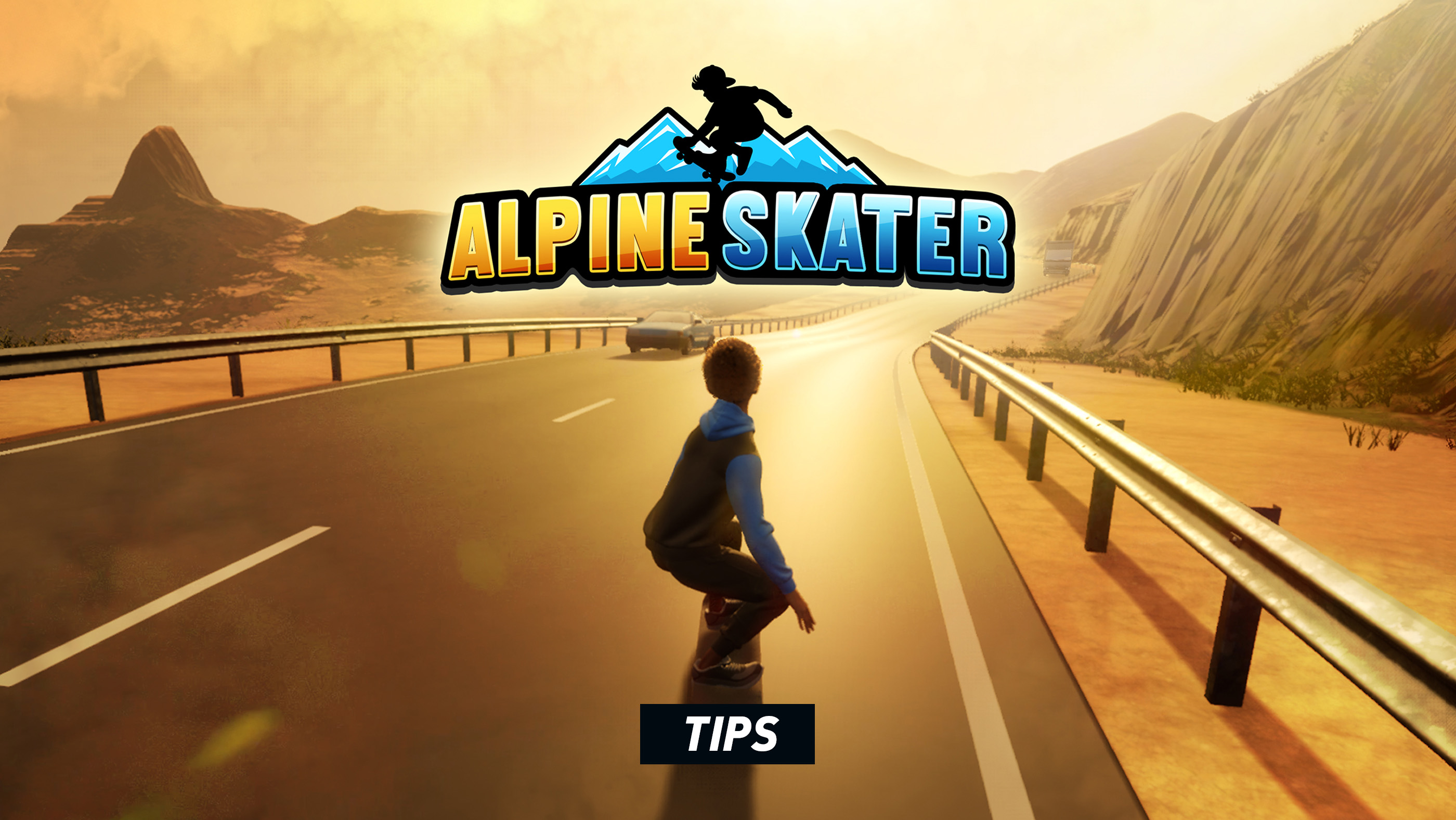
Alpine Skater looks like a straightforward downhill skating game, but the mountain setting changes how every approach, jump and landing behaves. Ice carries momentum farther, snow can reduce speed, rocky trails punish careless lines and indoor ramps reward much more precise positioning.
The fastest way to improve is not to memorize a huge trick list. It is to learn how each surface changes the board, identify the safest route through a challenge and attempt only the trick that the available airtime can support.
These spoiler-light tips cover steering, speed management, terrain physics, trick timing, rails, challenge objectives, restarts, playable skaters and completion of all 12 levels.
Use the First Run to Read the Course
Do not expect the first attempt at a new challenge to be the successful one. Use it to identify:
- The location of sharp turns.
- Which ramps are optional.
- Where the surface changes.
- Hazards hidden behind slopes.
- Safe landing areas.
- Shortcuts and risky lines.
- The final approach to the goal.
A scouting run makes the next serious attempt much more predictable.
Look Beyond the Skater
Keep your attention several metres ahead. Watching only the board leaves too little time to react to a rock, rail or corner.
Use the camera to inspect the next obstacle, then centre it again before taking off.
Learn How Each Surface Feels
The game's mountain environments have different physics and hazards. Do not use one steering rhythm on every track.
Turn Early on Ice
Icy ground preserves sideways momentum. Begin the turn before reaching the corner and gradually release the stick as the board lines up.
Preserve Momentum in Snow
Snowy surfaces can make unnecessary steering and braking more costly. Use a smooth route with fewer direction changes.
Choose a Clear Line Through Rocks
Do not steer separately around every obstacle. Look for the largest continuous opening and aim through the centre of it.
Practise Tricks Indoors
A skate hall or free-skating environment provides predictable ramps and repeatable approaches. Use it to learn airtime before trying the same trick on an uneven mountain jump.
Steer Less at High Speed
Large steering inputs become more disruptive as speed increases. A small correction that feels ineffective at low speed may be enough during a descent.
Release the Stick Before Oversteering
When the board begins turning toward the correct line, return the stick toward centre. Waiting until the board already points too far creates an endless chain of corrections.
Use Carving to Manage Speed
Moving diagonally across a slope reduces direct downhill acceleration. Gentle carving can control speed without the instability caused by sudden braking.
Brake Before Hazards
Do not wait until the skater is already beside a rock or entering a tight corner. Reduce speed while the route is still straight.
Approach Every Ramp Straight
Make the final major steering correction before reaching the ramp. The board should be stable during the last part of the approach.
Use the Centre of the Ramp
Taking off near an edge can produce an unintended sideways launch. Unless the challenge clearly requires a diagonal jump, aim for the centre.
Jump Near the Lip
A late, controlled takeoff normally produces more useful height than jumping near the bottom of the ramp.
Do Not Begin the Trick Too Early
Confirm that the skater is airborne before pressing a long trick combination. Starting during the takeoff can interfere with the launch.
Match Trick Length to Airtime
Small ramps are for small tricks. Large rotations and long grabs require enough height to return the skater to a neutral position.
Use this progression:
- Land a normal jump.
- Add one quick trick.
- Add a small rotation.
- Combine the two only after both are reliable.
End the Trick Early
The safest landing begins before the board reaches the ground. Release grabs and stop rotations while there is still visible air beneath the skater.
Do Not Add an Extra Rotation
Once the board faces the landing, stop. Another half-turn may look more impressive but often converts a successful run into a crash.
Value Clean Landings
A completed trick preserves speed and allows the challenge to continue. A failed trick loses time and may reset the skater behind the obstacle.
Land in the Direction of Travel
Try to align the board with the slope or track. A sideways landing creates immediate instability, especially on ice.
Use Downward Slopes
Landing on a descending surface absorbs the jump more naturally and carries momentum forward.
Pause Before Steering
Give the board a brief moment to settle. A large input at the exact moment of contact can cause a fall even when the rotation was correct.
Recover from Imperfect Landings
When the board lands slightly off-angle:
- Release the trick controls.
- Use a small steering correction.
- Avoid braking immediately unless an obstacle is close.
- Skip the next trick and regain control.
Line Up Rails from Farther Away
A rail approach should begin before the final ramp or jump. Waiting until the skater is airborne gives you very little control over the landing point.
Enter Parallel to the Rail
The closer the board is to the rail's direction, the easier the grind is to maintain.
Use Small Balance Corrections
Overcorrecting is the most common cause of falling from a grind. Tap toward the centre rather than holding the stick fully.
Watch the End of the Rail
Prepare for the exit before reaching it. Straighten the board and identify the landing surface.
Prioritize the Challenge Objective
A level may emphasize finishing, time, tricks or navigating a specific route. Do not perform unnecessary stunts when the objective mainly rewards reaching the end.
Finish First, Improve Later
Complete a safe run to learn the full course. Once the level is unlocked or understood, return for faster times or higher-risk tricks.
Do Not Use Every Ramp
Some ramps may exist as optional scoring opportunities. A slower or safer path can be better during a completion-focused run.
Choose One Risky Section
Instead of attempting dangerous tricks at every jump, select the largest and safest ramp for your main scoring move.
Restart Bad Attempts Early
When the challenge begins with a major crash or missed objective, restart instead of completing an already unsuccessful run.
An early restart is useful after:
- Missing the first important gate.
- Falling from the opening ramp.
- Entering an incorrect route.
- Losing a large amount of time immediately.
Continue Runs That Teach You Something
Do not restart every imperfect attempt. Continue when you still need to learn the later course.
Separate Practice from Record Attempts
During practice, experiment and accept crashes. During a serious attempt, use only movements already proven reliable.
Use Checkpoints as Rhythm Markers
Memorize the route in sections rather than as one long descent:
- Opening turn.
- First ramp.
- Rocky section.
- Rail or trick area.
- Final descent.
Knowing what comes after each checkpoint reduces surprise and makes speed control easier.
Build a Consistent Route
Once a line works, repeat it. Constantly changing routes prevents you from learning where to turn and jump.
Improve One Section at a Time
Do not attempt to make the entire run faster immediately. Identify the slowest or least reliable part and improve only that section.
Try Different Skaters
The game includes multiple playable skaters. Even when their statistical differences are limited, animation, stance or visual clarity may make one easier for you to control.
Choose Visibility Over Appearance
A skater whose clothing contrasts with the snow and terrain can be easier to track during fast rotations.
Relearn Timing After Switching
Different animations may make tricks appear faster or slower. Perform several simple jumps before attempting a record run with a newly selected character.
Use the Demo or Early Challenges for Practice
The demo contains two challenges, making it suitable for learning the game's handling before attempting the complete set of 12.
Practise:
- Small steering corrections.
- Braking before corners.
- Jump timing.
- One basic air trick.
- Rail alignment.
- Landing without immediate steering.
Repeat a Known Ramp
The fastest way to understand trick timing is to use the same ramp repeatedly. Changing ramps introduces different speed and airtime, making comparison harder.
Adjust the Camera Before the Challenge
Set sensitivity low enough to centre the path accurately but high enough to inspect upcoming corners.
Avoid Constant Camera Rotation
Frequent camera movement makes it harder to judge the board's actual direction. Change the view for a reason, then return it behind the skater.
Use a Wider View for Route Planning
When camera-distance options are available, a slightly wider view helps reveal hazards earlier.
Do Not Chase Complicated Combos Immediately
The game's trick system is easier to learn in layers. Build reliable inputs before combining them.
A sensible order is:
- Normal jump.
- Single grab.
- Small spin.
- Grab plus spin.
- Rail entry and exit.
- Multi-obstacle line.
Use Repetition, Not Random Inputs
Choose one trick and repeat it until you know how long its animation lasts. Random button pressing makes it difficult to understand why one landing succeeds and another fails.
Common Beginner Mistakes
- Holding full steering through every corner.
- Looking at the skater instead of the route.
- Entering ramps at an angle.
- Jumping too early.
- Attempting long tricks from small ramps.
- Continuing a rotation after the board is aligned.
- Landing while still holding a grab.
- Steering aggressively on touchdown.
- Approaching rails from the side.
- Using maximum speed in every section.
- Restarting before learning the later part of a course.
- Attempting risky tricks when the objective only requires completion.
- Using the same steering style on ice, snow and rocky terrain.
Frequently Asked Questions
How many levels are in Alpine Skater?
The full game contains 12 challenges.
What is included in the demo?
The demo provides two challenges and access to a limited portion of the skating experience.
What is the easiest way to land tricks?
Use a straight approach, choose a trick that fits the available airtime and release all trick inputs before touching down.
Why do I keep sliding off icy corners?
You are probably steering too late or too sharply. Begin turning earlier and release the input gradually.
Should I brake during a corner?
Brake before the corner whenever possible. Braking while already sliding can make the board harder to stabilize.
How do I get more airtime?
Approach the centre of the ramp with enough speed and trigger the jump close to its lip.
How do I stop over-rotating?
Release the rotational input as soon as the board begins facing the landing direction.
Why do I fall immediately after landing?
The board may be sideways, a trick input may still be held or you may be steering too strongly at contact.
How do I improve at grinding?
Approach parallel to the rail, land near its centre and use very small balance corrections.
Is maximum speed always better?
No. It helps on straight sections but reduces control on narrow routes, ramps and icy corners.
Should I use every ramp?
No. Choose ramps that support the current challenge objective and provide a clear landing.
When should I restart a run?
Restart after an early mistake that makes the objective impossible. Continue when the remaining course still contains sections you need to learn.
Are all mountain surfaces the same?
No. The environments have different physics, surface feel and hazards.
Are there multiple skaters?
Yes. Several skaters are available as you progress.
What is the best beginner strategy?
Complete a slow scouting run, memorize the course and then improve one difficult section at a time.
What is the most important trick tip?
Stop the trick before landing. Preparing the board early is more reliable than trying to complete one final rotation at the last moment.
Final Advice
Alpine Skater rewards preparation more than reckless speed. Read each mountain as a sequence of surfaces, turns and landing zones rather than one uninterrupted descent.
Use smooth steering, choose tricks that fit the ramp and restart only after deciding what went wrong. Once your basic line is reliable, higher speed and more complicated combinations become much easier to add.
Read our Alpine Skater Controls Guide for movement, camera control, speed management, jumps, tricks, rails, resets and controller setup.
Comments
No comments yet. Be the first to share your thoughts!