Sword of the Sea is not a traditional action game where success depends on defeating every creature or collecting stronger weapons. Its real challenge is learning to read a world made from moving lines: the slope beneath the Hoversword, the crest of the next wave, the curve of a ruined wall, and the distant landmark that quietly suggests a hidden route.
You can follow the central journey and enjoy the game at a relaxed pace, but curious players will find Ocean Seeds, Secret Shells, ancient Stele, Tetra, hidden vendors, optional Trick Attack areas, unusual creatures, and secluded corners far beyond the obvious route.
These Sword of the Sea tips focus on fluid movement, efficient exploration, trick scoring, collectible hunting, and the small visual clues that make the world easier to understand.
Let the Landscape Choose Your Route
The fastest line is rarely a straight line. Riding directly toward an objective can force the Hoversword up steep inclines, drain momentum, and leave you with a weak jump at the top.
Look for a curved route that descends before rising again. Dropping into a basin gives the board room to accelerate, and the opposite face becomes a natural launch ramp. This rhythm of descent, acceleration, and ascent is the foundation of traversal.
Build Speed Before Thinking About Height
When a ledge appears unreachable, most players concentrate on pressing Jump at exactly the right moment. The approach is usually more important.
Move farther back, find a steeper descent, use boost, and approach the ramp smoothly. A fast takeoff from a modest incline can carry the Wraith farther than a slow jump from a dramatic cliff.
Jump from the Lip, Not the Middle of the Ramp
Allow the Hoversword to climb most of the ramp before jumping. Taking off too early wastes the upward shape of the terrain and produces a low arc.
Watch the Wraith rather than the distant destination. Press Jump as the board nears the upper edge, then use the second jump only after the first arc is established.
Delay the Second Jump
Pressing Jump twice immediately feels responsive, but it often wastes the extra lift. Save the airborne input until the Wraith is near the top of the first jump or begins falling short of the landing.
A delayed second jump gives you more time to correct the direction and makes it easier to decide whether additional height is actually necessary.
Use Drop to Preserve Flow
Drop is not merely a way to fall faster. It is a tool for controlling where the next movement sequence begins.
Use it when you are floating beyond the best landing zone, when you want to reconnect with a downhill slope, or when a trick has finished and additional airtime no longer helps. Landing earlier on a useful descent can produce more speed than remaining airborne.
Aim for the Downward Side of the Next Wave
A technically successful landing can still destroy momentum if the Wraith touches down while facing uphill. Whenever possible, land just beyond a crest on the descending side.
The slope will immediately accelerate the board and carry the movement into the next jump. This creates a smooth chain instead of a series of isolated leaps.

Use Boost Where It Can Work
Boost cannot turn every surface into a fast route. Holding it while facing a steep wall mostly produces noise and frustration.
Activate boost on open water, broad declines, long straightaways, and the final approach to a jump. Release it when entering a confined area or preparing for a sharp correction.
Water Is a Movement Upgrade
Activating Ocean Seeds does more than change the scenery. Restored water allows the Wraith to travel considerably faster, while returning marine life can create jump pads, climbable structures, grind routes, and new ways into previously awkward spaces.
After restoring an area, do not immediately leave. Ride through it again. The best route through the transformed version may be completely different from the path you used while it was dry.
Revisit the Shoreline After Every Major Transformation
When water returns, the border between land and sea becomes especially useful. Shorelines often create long, curved surfaces where you can build speed before launching back onto ruins or elevated terrain.
Follow the new edge of the water in both directions. It may lead to a hidden collectible, an animal, a vendor, or a route that was not practical before the transformation.
Activate Ocean Seeds Before Exhaustive Searching
Searching every corner of a dry region before restoring it can be inefficient. Ocean Seeds reshape the area, reveal striking landmarks, introduce marine life, and provide faster routes.
Explore enough to understand the layout, activate the available Seeds, and then perform a more detailed sweep. The transformed environment often makes distant platforms and concealed paths easier to recognize.
Use Tall Landmarks as Navigation Anchors
Sword of the Sea does not rely on a conventional minimap during exploration. Instead, learn the position of towers, arches, statues, mountain peaks, temples, and large ruins.
Whenever you enter a broad area, identify two or three unmistakable landmarks. Mentally divide the region into sections around them and search one section at a time rather than wandering randomly.
Turn Around After Reaching a Major Landmark
The game carefully frames the path ahead, which naturally keeps your attention pointed forward. Collectibles are frequently easier to see from the opposite direction.
After reaching a temple, high platform, tunnel exit, or Ocean Seed, rotate the camera and look back across the route you just travelled. Raised shells, side ledges, and hidden openings often stand out from that angle.
Check Behind the Place the Camera Wants You to Look
When the camera presents an enormous vista or an obvious objective, pause before moving toward it. Examine the sides and the space behind your arrival point.
Environmental composition is often used to guide progression, making areas outside that composition ideal places to conceal optional discoveries.
Follow Schools of Fish and Moving Wildlife
Marine life is not always a formal waypoint, but its movement can make a route feel visually important. Fish may sweep through an opening, circle a structure, or draw the eye toward an elevated path.
Treat unusual concentrations of wildlife as soft hints. At minimum, they often lead to beautiful routes; at best, they reveal a secret or traversal opportunity.
Look for Surfaces That Continue Beyond the Main Route
Rails, roots, ruined walls, roof edges, and flowing ribbons of sea life may appear decorative until you notice that they extend around a corner or climb above the normal path.
Follow their direction with the camera before committing. A long continuous line is often an invitation to grind or wall ride toward an optional area.
Explore Vertically, Not Just Horizontally
Secrets are frequently above the comfortable riding line. Check the tops of ruins, elevated arches, narrow stone spines, and platforms that require several connected jumps.
When you see a high destination, first search for a lower wave or ramp that points toward it. The intended route may begin much farther away than expected.
Search Below Large Structures
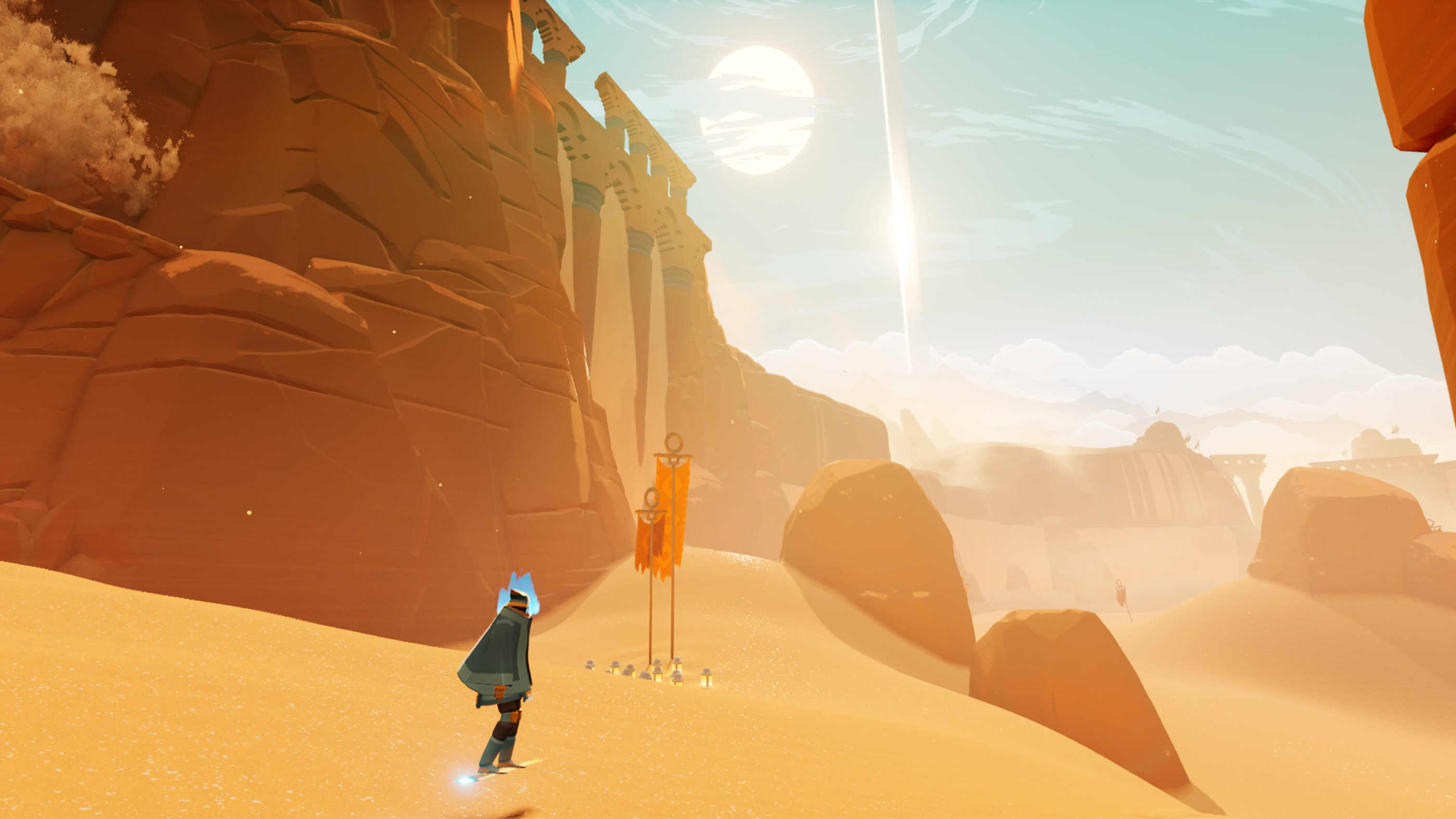
Bridges, temples, arches, and massive rock formations naturally pull the eye upward. Their lower sections can hide tunnels, small caves, collectible alcoves, and alternate exits.
Circle the base before riding over the top. A hidden lower route may eventually return you to the same landmark from a more rewarding direction.
Collect Tetra Even When You Are Not Completion Hunting
The golden triangular Tetra scattered throughout the world serve as currency. Vendors exchange them for new tricks and abilities, so collecting Tetra expands what the Hoversword can do rather than merely increasing a counter.
Ride through nearby clusters whenever you see them. A few brief detours throughout the journey are less disruptive than searching for a large amount later when a vendor offers something you want.
Follow Tetra Trails Carefully
A line of Tetra frequently teaches a route. It may curve across a wall ride, continue over several waves, pass through a narrow ruin, or end near a hidden object.
Do not stare only at each individual triangle. Look several pieces ahead so you understand the shape of the complete path before entering it at speed.
Return to Vendors with a Healthy Reserve
Vendors can be hidden away from the direct route, and new techniques become more expensive as your collection grows. Arriving with only a small amount of Tetra may leave you unable to purchase the move that interests you most.
Keep a reserve instead of assuming every vendor is encountered at a convenient point in the story.
Choose Tricks by Utility as Well as Appearance
Every new trick adds style, but the most useful purchase is the one you can comfortably include in a combination. A spectacular move provides little value in Trick Attack if its input repeatedly disrupts your landing.
Buy a move, practice it in open terrain, and learn how long the animation lasts before adding another technique to the routine.
Do Not Confuse Tricks with Required Progression
Most normal exploration does not require a huge trick score. Tricks are primarily a source of expression, optional scoring, and challenge completion.
When a platform seems unreachable, solve the movement problem with speed, terrain, boost, jump timing, wall rides, or restored sea life rather than assuming a more advanced trick is required.
Start Trick Practice on Broad, Forgiving Waves
Do not learn a new combination over a narrow ledge or bottomless drop. Find a broad dune with a clean approach and a wide landing.
Practice the takeoff and landing first. Once those are repeatable, add Trick Mode and one face-button input. Add spins, grabs, or additional actions only after the basic sequence feels safe.
Separate the Trick from the Landing
A trick is not complete merely because the animation appeared. You still need time to align the Hoversword with the landing surface.
Finish complicated inputs early enough to see the terrain below. Use the remaining airtime to straighten the board and decide whether Drop will improve the landing.
Use Height for Tricks and Distance for Travel
The highest possible jump is ideal for longer trick sequences, but it may not be the fastest way across an area. Excess airtime can interrupt forward flow.
Choose your jump according to the goal. Seek height in Trick Attack arenas; seek a low, fast arc when covering distance or chaining slopes.
Combine Different Types of Movement
Longer sequences feel better when they contain variety. Build speed, jump, perform a trick, reconnect with a grindable surface, leave the rail, and land on a descending wave.
Repeatedly using the same simple move may be safe, but varied actions generally make better use of the environment and help you understand the full movement system.
Enter Trick Attack Areas with Momentum
Do not begin an optional score challenge from a standstill when the surrounding area provides a downhill approach. Build speed outside the arena and cross the starting point already moving quickly.
The opening seconds establish the rhythm of the run. Strong initial momentum gives you earlier airtime and more opportunities to link actions.
Learn the Arena Before Chasing a High Score
Use the first attempt to identify ramps, rails, walls, turns, and the safest landing zones. A planned route is more reliable than reacting to each obstacle at the last moment.
Once you know the circuit, decide where to perform the longest trick and where to use simpler actions to preserve control.
Prioritize Clean Landings Over One Extra Trick
Adding another move at the end of a jump may increase the theoretical value of the combination, but losing the landing interrupts the run.
End inputs earlier when the surface below is narrow, angled, or difficult to see. Consistency produces better results than one risky attempt surrounded by failed runs.
Listen for Secret Shells
Secret Shells are deliberately tucked away from the central route. Slow down in enclosed spaces, quiet ruins, dead ends, and secluded platforms, and pay attention to unusual audio cues.
Headphones can make subtle directional sounds easier to place. Rotate the camera and move in a small circle to judge whether the source is above, below, or behind a wall.
Check the End of Every Suspicious Dead End
A route that appears unnecessary is often unnecessary for story progression but valuable for exploration. Continue to the true endpoint before turning back.
Small caves, isolated balconies, and narrow paths with no obvious exit are natural locations for shells and other optional discoveries.
Read Every Stele When You Find It
Stele provide fragments of the world’s history and give context to the Wraith’s journey. They are easy to overlook when travelling at full speed because their purpose is quieter than an Ocean Seed or dramatic transformation.
Approach unusual carved stones and monuments slowly. Even players uninterested in collecting everything will gain a clearer understanding of the story by reading them.
Search for Frogs in Places That Feel Too Small to Matter
Hidden frogs are among the easiest discoveries to pass. They may occupy tiny side spaces that do not resemble full exploration routes.
Investigate shallow pools, sheltered corners, small ledges, and enclosed natural spaces. Listen as well as look; a small creature may be easier to hear than to see against the environment.
Ride Every Unusual Animal You Can Reach
Some restored creatures can be ridden, creating a dramatic change from normal Hoversword travel. Approach calmly and watch for the interaction prompt rather than repeatedly colliding with the animal at boost speed.
Animal routes may reveal new views and contribute to optional achievements, so do not treat them as background decoration.
Keep Your Own Chapter Notes
The pause menu shows broad collectible progress, but it is still wise to note which areas contained an unresolved sound, unreachable ledge, or suspicious structure.
A simple note such as “high arch beside the second Ocean Seed” is more useful than trying to remember an entire landscape several chapters later.
Do Not Assume Chapter Select Tracks Every Detail for You
Chapter Select is useful for revisiting locations, but collectible information may not always identify the exact item or sub-area you missed. Search methodically rather than expecting a marker to lead directly to the remaining secret.
Divide a replayed chapter into recognizable zones and fully inspect one before moving to the next.
Use the Camera as a Scouting Tool
Before attempting a difficult jump, stop at a high point and move the camera independently. Locate the landing, study its angle, and check what lies beyond it.
A landing that looks flat from the front may actually slope away sharply. Knowing this before takeoff helps you choose whether to boost, save the second jump, or prepare to Drop.
Reset the Camera Before Precision Sections
Exploring with a cinematic side angle looks beautiful, but it can make a narrow route harder to judge. Use Reset Camera to place the view behind the Wraith before entering a tunnel, rail, or closely spaced sequence of ramps.
Once the difficult section is complete, return to a wider viewing angle for exploration.
Slow Down When a Prompt Appears
Interaction prompts may flash briefly as you pass an Ocean Seed, vendor, Stele, or mechanism. Do not try to activate everything at maximum speed.
Release boost, curve around, and approach again. The game is forgiving about proximity, but it cannot help when momentum carries you immediately out of range.
Do Not Fight the Automatic Assistance
Sword of the Sea gently guides the Wraith toward certain rails, jump pads, sea creatures, and interactive routes. Large steering corrections at the last moment can pull you away from that assistance.
Once the intended connection begins, reduce your input and let the movement settle before choosing the next direction.
Use Photo Mode to Study the Environment
Photo Mode is not only for screenshots. Pausing the action and moving the camera can help you inspect the architecture around a collectible, understand how a path curves, or examine a dramatic transformed region from another angle.
It should not replace normal exploration, but it can clarify a confusing space without forcing another high-speed pass.
Adjust Vibration Before Turning It Off
The DualSense controller responds differently to sand, water, stone, tiles, and other surfaces. Those changes reinforce the sensation of speed and may help you notice when the board crosses onto terrain with different movement properties.
When full-strength vibration feels tiring, lower the value in the controller settings rather than disabling the feature immediately.
Try Another Preset When Tricks Feel Awkward
The default controls are excellent for general exploration, but holding Trick Mode while pressing face buttons may not suit every hand position.
Open the Controls menu and test the alternative presets. Some layouts simplify trick inputs or distribute them differently across the controller.
Remap Before Building Muscle Memory
Change an uncomfortable action early. Relearning Jump, Drop, or Trick Mode after several hours is harder than choosing a comfortable layout during the opening area.
Make sure the final arrangement still allows you to steer, move the camera, jump, and trigger tricks without shifting your grip dramatically.
Use a DualSense Natively on PC
For native DualSense functionality on the Steam version, disable Steam Input for Sword of the Sea as recommended on the store page. This allows the game’s full controller implementation to handle the device directly.
When you prefer an Xbox-style controller or a custom Steam layout, Steam Input can remain useful, but the native DualSense effects may differ.
Do Not Rush the Main Path
Sword of the Sea is a focused journey, and following only the obvious route can carry you through an area surprisingly quickly. Its optional discoveries are part of the intended experience rather than filler placed outside it.
Whenever the music relaxes and the landscape opens, give yourself permission to turn away from the objective. Some of the game’s most memorable views are found in places the story never requires you to visit.
Explore Before and After Restoring the Sea
Dry and restored versions of an area communicate different information. The dry landscape makes architecture and elevation easier to read, while the restored landscape creates speed, wildlife, and new traversal possibilities.
A thorough search therefore has two phases: learn the structure first, then return after the transformation and examine what has changed.
Follow Curiosity, Not Only Collectible Counts
Not every unusual path ends with a formal collectible. Some provide a sweeping descent, a hidden view, an encounter with wildlife, or a particularly satisfying sequence of waves.
The movement itself is one of the game’s rewards. A detour is not wasted simply because no counter increases at the end.
Let the Music and Environment Set the Pace
Constant boost is not always the best way to experience the world. Slow down around murals, Stele, newly restored habitats, and quiet ruins.
The story is communicated through images, spaces, motion, and music as much as through explicit text. Rushing can make important environmental details feel invisible.
Save Completion Cleanup for After You Understand the Movement
Trying to collect everything immediately can make early exploration frustrating because your control of momentum, jumps, drops, and wall rides is still developing.
Complete the main route naturally, learn the Hoversword, purchase useful tricks, and then revisit difficult secrets. A jump that once felt impossible may become straightforward through practice alone.
Frequently Asked Questions
What should I do first in a new area?
Identify major landmarks, explore the obvious side paths, locate Ocean Seeds, and restore the sea before performing a detailed collectible sweep. The transformation frequently opens faster and more useful routes.
How do I reach high places?
Search for a downhill approach rather than jumping repeatedly below the ledge. Build speed, boost toward a rising wave or ramp, jump near the lip, and delay the second jump until midair.
What are the golden triangles?
They are Tetra, the game’s currency. Hidden vendors exchange Tetra for new Hoversword tricks and abilities.
Are tricks required to finish the story?
Basic progression focuses more on movement, exploration, interactions, and environmental routes. Advanced tricks are especially valuable for optional Trick Attack challenges and high-score play.
What do Ocean Seeds do?
Ocean Seeds cleanse parts of the world and restore water and marine life. These changes can increase travel speed, create new paths, and introduce useful creatures such as jump pads or climbable seaweed.
How do I find Secret Shells?
Search dead ends, caves, elevated ruins, hidden lower routes, and secluded corners. Slow down and listen for distinctive audio cues, preferably with headphones.
Can I return for missed collectibles?
Yes. Chapter Select allows areas to be revisited. Keeping personal notes is helpful because the game may not identify the precise location of each missing collectible.
How do I improve my Trick Attack score?
Enter the arena with momentum, learn its layout, connect varied movements, finish trick inputs before landing, and favor consistent combinations over one excessively risky jump.
Why do I keep falling short of jumps?
The problem is usually approach speed or takeoff position. Begin farther away, use a descent to accelerate, hold boost, jump near the ramp’s edge, and avoid spending the second jump too early.
Is there combat in Sword of the Sea?
Sword of the Sea contains dramatic confrontations, but it is primarily a movement-and-exploration adventure rather than a conventional combat game. The Hoversword is mainly a traversal tool, not a standard melee weapon.
How long should I explore before moving forward?
Move on when you have activated the area’s main transformations and feel satisfied with your search. Completionists should perform a second sweep after the water returns, while story-focused players can return through Chapter Select.
Final Advice
The best Sword of the Sea tip is to stop treating the Hoversword like a vehicle that simply moves forward. It is a conversation with the landscape. Every descent offers speed, every crest offers a choice, every restored ocean changes the rhythm, and every landing prepares the next movement.
Use broad curves, delay your second jump, Drop onto useful slopes, explore transformed regions twice, and investigate anything that breaks the visual pattern. Once you learn to read the world as a continuous wave, both the main journey and its hidden routes begin to flow naturally.
See our Sword of the Sea Controls Guide for controller buttons, keyboard support, Boost, Drop, Trick Mode, Photo Mode, presets, and remapping instructions.
Comments
No comments yet. Be the first to share your thoughts!